Mathematics
Times Tables: 2, 5 and 10
Multiplication — the 2, 5 and 10 times tables
Learn what multiplying means, master the 2, 5 and 10 times tables, and use them to solve money problems in cedis.
What is multiplication?
Ama's mother sells eggs at Makola Market. She packs them in trays of ten. Three customers each buy a tray. How many eggs is that?
Ama could count every egg: 1, 2, 3 … all the way to 30. That takes a long time. Instead she says: "Three trays of ten. That is three times ten. Thirty!"
Multiplication is a quick way of adding the same number again and again. When every group is the same size, we multiply.
The sign for multiplication is ×. We read it as "times" or "multiplied by".
3 × 10 = 30 means "three groups of ten make thirty".
In this book you will learn the 2, 5 and 10 times tables, and how to use them at the market, at school and at home.

2 / 41
Repeated addition
Kofi has 4 bags. Each bag has 2 oranges. How many oranges?
He can add: 2 + 2 + 2 + 2 = 8.
That is four 2s added together. Adding the same number over and over is called repeated addition. Multiplication is a short way of writing it:
4 × 2 = 8
The first number tells us how many groups. The second number tells us how many in each group.
Look at these pairs. They say the same thing:
- 3 + 3 = 6 → 2 × 3 = 6
- 5 + 5 + 5 = 15 → 3 × 5 = 15
- 10 + 10 + 10 + 10 = 40 → 4 × 10 = 40
Try this: Write 2 + 2 + 2 + 2 + 2 as a multiplication. How many 2s are there?
3 / 41
Groups of things
Think of things that come in equal groups.
- A pair of slippers has 2 slippers.
- One hand has 5 fingers.
- A box of chalk has 10 sticks.
- A trotro has 4 wheels.
- A bicycle has 2 wheels.
When we know the size of one group, we can find the total for many groups by multiplying.
Abena sees 6 bicycles outside the school. How many wheels? Each bicycle has 2 wheels, so she needs 6 × 2. That is 2 + 2 + 2 + 2 + 2 + 2 = 12 wheels.
Try this: Think of three more things that come in groups of 2, 5 or 10. Say a multiplication for each one.
4 / 41
Arrays: rows and columns
An array is a neat arrangement of things in rows and columns, like eggs in a tray or seats in a classroom.
Look at this array of dots:
● ● ● ● ● ● ● ● ● ● ● ● ● ● ●
There are 3 rows. Each row has 5 dots. So the array shows 3 × 5 = 15.
Arrays help us see multiplication. Count the rows, count the dots in one row, then multiply.
Now turn the array on its side. Then there are 5 rows of 3. That is 5 × 3, and it is still 15! The order does not change the answer.
Try this: Draw an array with 4 rows of 2 dots. Write the multiplication underneath.

5 / 41
Making arrays with stones
You do not need a book to make an array. Collect some small stones or bottle tops.
- Put 2 stones in a row.
- Put another row of 2 underneath.
- Keep adding rows of 2 until you have 5 rows.
Now count the rows: 5. Count the stones in one row: 2. The array shows 5 × 2. Count all the stones: 10.
Try arrays of 5: make rows of 5 stones. Two rows show 2 × 5 = 10. Three rows show 3 × 5 = 15.
Try arrays of 10: make rows of 10 stones. Two rows show 2 × 10 = 20.
Try this: Make an array that shows 4 × 5. How many stones did you use?
6 / 41
Skip counting
Skip counting means counting in jumps instead of one by one.
Count in 2s: 2, 4, 6, 8, 10, 12, 14, 16, 18, 20
Count in 5s: 5, 10, 15, 20, 25, 30, 35, 40, 45, 50
Count in 10s: 10, 20, 30, 40, 50, 60, 70, 80, 90, 100
Skip counting is the secret behind the times tables. Every number you land on is an answer in the table.
When you count in 2s, the third number you say is 6. That is 3 × 2 = 6.
When you count in 5s, the fourth number you say is 20. That is 4 × 5 = 20.
Try this: Clap as you count in 5s to 50. Then count in 10s to 100 while hopping on one foot.
7 / 41
Skip counting on a number line
A number line helps us see the jumps.
Start at 0. Jump in 2s:
0 → 2 → 4 → 6 → 8 → 10
Five jumps of 2 land on 10. So 5 × 2 = 10.
Now jump in 5s:
0 → 5 → 10 → 15 → 20
Four jumps of 5 land on 20. So 4 × 5 = 20.
Jump in 10s:
0 → 10 → 20 → 30
Three jumps of 10 land on 30. So 3 × 10 = 30.
Each jump is one group. The number of jumps is the first number in the multiplication. Where you land is the answer.
Try this: Draw a number line from 0 to 20. Show 10 jumps of 2. Where do you land?
8 / 41
The 2 times table
Here it is. Read it aloud, slowly.
- 1 × 2 = 2
- 2 × 2 = 4
- 3 × 2 = 6
- 4 × 2 = 8
- 5 × 2 = 10
- 6 × 2 = 12
- 7 × 2 = 14
- 8 × 2 = 16
- 9 × 2 = 18
- 10 × 2 = 20
Every answer is a number you say when you count in 2s. Every answer is an even number: it ends in 0, 2, 4, 6 or 8.
Say it again, and this time tap the desk on each answer.
9 / 41
Doubling
Multiplying by 2 is the same as doubling. Double means "two of".
Double 3 is 3 + 3 = 6. So 3 × 2 = 6.
Double 7 is 7 + 7 = 14. So 7 × 2 = 14.
Kwame has 8 pencils. His sister has the same number. Together they have double 8, which is 16 pencils. That is 8 × 2 = 16.
Doubling is useful at the market. If one bofrot costs GH₵2, two bofrot cost double: GH₵4.
Try this: Double these numbers in your head.
- Double 4
- Double 6
- Double 9
- Double 10
Check each answer in the 2 times table.
10 / 41
Pairs everywhere
Things that come in pairs give us the 2 times table.
Eyes, ears, hands, feet, slippers, socks, earrings, bicycle wheels.
Abena lines up 7 pairs of slippers at the door of the house. How many slippers? 7 × 2 = 14 slippers.
There are 9 children in the room. How many eyes? 9 × 2 = 18 eyes.
A pack of exercise books costs GH₵2 each. Kofi buys 6. He pays 6 × 2 = GH₵12.
Try this: Count the pairs of shoes in your house. Multiply by 2 to find the number of shoes. Then count the shoes one by one to check.
11 / 41
Practise the 2 times table
Cover the answers with your hand. Say the answer, then peek.
- 2 × 2 = ?
- 5 × 2 = ?
- 3 × 2 = ?
- 8 × 2 = ?
- 1 × 2 = ?
- 10 × 2 = ?
- 6 × 2 = ?
- 4 × 2 = ?
- 9 × 2 = ?
- 7 × 2 = ?
Now try it backwards. What times 2 gives 12? What times 2 gives 18?
Try this: Ask a friend to call out a number from 1 to 10. You shout the answer times 2. Then swap.
12 / 41
The 5 times table
Read it aloud.
- 1 × 5 = 5
- 2 × 5 = 10
- 3 × 5 = 15
- 4 × 5 = 20
- 5 × 5 = 25
- 6 × 5 = 30
- 7 × 5 = 35
- 8 × 5 = 40
- 9 × 5 = 45
- 10 × 5 = 50
Look at the last digit of each answer: 5, 0, 5, 0, 5, 0 … Every answer in the 5 times table ends in 5 or 0. That is a quick check. If your answer ends in 3, something has gone wrong.
Try this: Which of these could be in the 5 times table: 25, 32, 40, 17, 45?
13 / 41
Fingers: five on each hand
Hold up one hand. Five fingers. Hold up two hands. Ten fingers.
Fingers are a ready-made 5 times table.
- 1 hand → 5 fingers → 1 × 5 = 5
- 2 hands → 10 fingers → 2 × 5 = 10
- 3 hands → 15 fingers → 3 × 5 = 15
Four children hold up both hands. That is 8 hands. 8 × 5 = 40 fingers.
The class has 10 children. They each hold up one hand. 10 × 5 = 50 fingers.
Try this: Stand in a line with friends. Each person holds up one hand. Count in 5s along the line. Then everyone holds up both hands and you count again.

14 / 41
Fives on the clock
Look at a clock face. The numbers 1 to 12 go round the edge. Between each number there are 5 minutes.
When the long hand points to 1, it is 5 minutes past. When it points to 2, it is 10 minutes past. When it points to 3, it is 15 minutes past.
The clock is a 5 times table going round in a circle! 3 × 5 = 15, so the number 3 means 15 minutes.
The long hand points to 6. That is 6 × 5 = 30 minutes past the hour. We call it half past.
Try this: Look at a clock. Pick a number on it and multiply it by 5. That is how many minutes past the hour when the long hand points there.
15 / 41
Fives and money
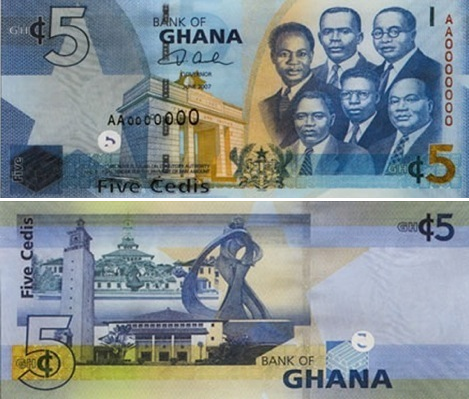
Some Ghana coins and notes are worth 5: the 5 pesewa coin and the GH₵5 note.
Ama saves one GH₵5 note every week. After 4 weeks she has 4 × 5 = GH₵20.
A sachet of water costs 50 pesewas. Hmm, that is not 5. But 10 pesewas × 5 = 50 pesewas, so one sachet costs the same as five 10-pesewa coins.
Kofi's uncle gives him GH₵5 every time he visits. He visits 7 times. Kofi gets 7 × 5 = GH₵35.
Try this: How much are six GH₵5 notes worth? How much are nine GH₵5 notes worth?
16 / 41
Practise the 5 times table
Cover, say, peek.
- 3 × 5 = ?
- 7 × 5 = ?
- 1 × 5 = ?
- 10 × 5 = ?
- 4 × 5 = ?
- 8 × 5 = ?
- 2 × 5 = ?
- 6 × 5 = ?
- 9 × 5 = ?
- 5 × 5 = ?
Remember the check: every answer ends in 5 or 0.
Now backwards: what times 5 gives 35? What times 5 gives 20? What times 5 gives 50?
Try this: Write the 5 times table in your exercise book without looking. Then open the book and mark your work.
17 / 41
The 10 times table
Read it aloud.
- 1 × 10 = 10
- 2 × 10 = 20
- 3 × 10 = 30
- 4 × 10 = 40
- 5 × 10 = 50
- 6 × 10 = 60
- 7 × 10 = 70
- 8 × 10 = 80
- 9 × 10 = 90
- 10 × 10 = 100
Do you see the pattern? To multiply a number by 10, write the number and put a 0 on the end.
3 × 10: write 3, add 0 → 30. 8 × 10: write 8, add 0 → 80.
Every answer in the 10 times table ends in 0.
Try this: What is 6 × 10? What is 9 × 10? Say them straight away.
18 / 41
Tens and place value
Why does "add a zero" work?
Our numbers are built from tens and ones. The number 7 is 7 ones. When we multiply by 10, the 7 ones become 7 tens. We write 7 tens as 70: the 7 moves into the tens place, and a 0 holds the ones place.
| Tens | Ones |
|---|---|
| 7 | |
| 7 | 0 |
So 7 × 10 = 70 is not magic. It is 7 tens.
The same thing happens with 10 × 10. Ten tens make one hundred: 100.
Try this: Write 4 × 10 in a tens-and-ones table. Then write 10 × 10. Where does the 1 go?
19 / 41
Tens at the market
At the market many things come in tens.
A tray of eggs holds 30, which is 3 rows of 10. A bundle of pencils has 10. A box of matches might hold 10 sticks in a row.
Ama buys 4 small packs of pure water. Each pack has 10 sachets. 4 × 10 = 40 sachets.
Tomatoes are sold in piles. The seller says, "GH₵10 a pile." Kofi's mother buys 3 piles. She pays 3 × 10 = GH₵30.
Kwame counts 10 toffees in each packet. He has 7 packets. 7 × 10 = 70 toffees.

20 / 41
Practise the 10 times table
This one is quick. Cover, say, peek.
- 2 × 10 = ?
- 9 × 10 = ?
- 5 × 10 = ?
- 1 × 10 = ?
- 7 × 10 = ?
- 10 × 10 = ?
- 3 × 10 = ?
- 6 × 10 = ?
- 8 × 10 = ?
- 4 × 10 = ?
Backwards: what times 10 gives 60? What times 10 gives 100?
Try this: Count in 10s from 10 to 100 while bouncing a ball. Then count backwards from 100 to 10.
21 / 41
The order does not matter
Here is a useful trick. 2 × 5 and 5 × 2 give the same answer: 10.
Why? Look at the array:
● ● ● ● ● ● ● ● ● ●
Two rows of 5 is 2 × 5. Turn your head sideways: five columns of 2 is 5 × 2. Same dots, same total.
So if you know 10 × 2 = 20, you also know 2 × 10 = 20. If you know 4 × 5 = 20, you also know 5 × 4 = 20.
This cuts the work in half. Learn one, and you get the other free.
Try this: 7 × 2 = 14. What is 2 × 7? 3 × 10 = 30. What is 10 × 3?
22 / 41
Multiplying by 1 and by 0
Two special cases.
Multiplying by 1. One group of 5 is just 5. So 1 × 5 = 5, and 5 × 1 = 5. Any number times 1 stays the same.
Multiplying by 0. Zero groups of 5 is nothing at all. So 0 × 5 = 0. And 5 × 0 means five groups with nothing in them: still 0. Any number times 0 is 0.
Abena has 0 bags of oranges. Each bag would hold 10. How many oranges does she have? 0 × 10 = 0. No bags, no oranges.
Try this: What is 1 × 10? What is 0 × 2? What is 8 × 1?
23 / 41
Word problems: step by step
A word problem is a story with a question. Here is how to solve one.
Kofi buys 6 pencils. Each pencil costs GH₵2. How much does he pay?
- Read it twice.
- Find the groups. 6 pencils, GH₵2 each. Six groups of 2.
- Write the multiplication. 6 × 2.
- Work it out. 6 × 2 = 12.
- Answer in a sentence. Kofi pays GH₵12.
Always put the unit in the answer: cedis, eggs, wheels. A number on its own does not say what it counts.
Try this: Ama buys 3 exercise books at GH₵5 each. Follow the five steps.
24 / 41
Word problems with 2
Solve each one. Write the multiplication and the answer.
A trotro mate collects GH₵2 from each of 9 passengers. How much does he collect?
Abena's class lines up in pairs. There are 8 pairs. How many children are in the line?
Kwame buys 5 bofrot at GH₵2 each. How much does he spend?
Each table in the classroom seats 2 pupils. There are 10 tables. How many pupils can sit down?
Worked answer for 1: nine passengers, GH₵2 each → 9 × 2 = 18. The mate collects GH₵18.

25 / 41
Word problems with 5
One ball of kenkey costs GH₵5. Ama's mother buys 4. How much does she pay?
There are 6 boys in a group. Each boy holds up one hand. How many fingers are up?
A packet of biscuits has 5 biscuits. Kofi has 7 packets. How many biscuits?
Abena saves GH₵5 every week for 10 weeks. How much has she saved?
Worked answer for 4: ten weeks, GH₵5 each week → 10 × 5 = 50. Abena has saved GH₵50.
Check: the answer ends in 0, so it could be in the 5 times table. Good.
26 / 41
Word problems with 10
A bundle of pencils has 10 pencils. The teacher buys 6 bundles. How many pencils?
One pile of tomatoes costs GH₵10. Kwame's aunt buys 5 piles. How much does she pay?
Eggs are packed in rows of 10. A tray has 3 rows. How many eggs?
Ama walks 10 minutes to school each morning. How many minutes does she walk in 5 school mornings?
Worked answer for 2: five piles, GH₵10 each → 5 × 10 = 50. She pays GH₵50.
Try this: Make up your own problem about buying things at GH₵10 each. Give it to a friend to solve.
27 / 41
Mixed problems
Now you have to decide: is it 2, 5 or 10?
A bicycle has 2 wheels. How many wheels on 7 bicycles?
A GH₵5 note. Nine of them. How much money?
Ten toffees in a packet. Four packets. How many toffees?
Slippers come in pairs. Six pairs. How many slippers?
Five fingers on a hand. Eight hands. How many fingers?
A box of chalk has 10 sticks. The school buys 10 boxes. How many sticks?
Underline the group size in each problem first. That tells you which table to use.
28 / 41
Counting money
At the shop, coins and notes come in different values. Multiplication helps you add them up quickly.
Kofi empties his pocket. He has six 10-pesewa coins. 6 × 10 = 60 pesewas.
Ama has four GH₵2 notes. 4 × 2 = GH₵8.
Abena has three GH₵5 notes. 3 × 5 = GH₵15.
Kwame has two GH₵10 notes. 2 × 10 = GH₵20.
Who has the most money? Kwame, with GH₵20. Who has the least? Kofi, with 60 pesewas, which is less than GH₵1.
Try this: Look at the coins at home. Sort them into piles of the same kind. Multiply to find the value of each pile.

29 / 41
Finding the missing number
Sometimes the answer is given and a number is missing.
? × 5 = 30
Ask: how many 5s make 30? Count in 5s: 5, 10, 15, 20, 25, 30. That is six 5s. The missing number is 6.
4 × ? = 40
Four of something makes 40. Try the tables you know. 4 × 2 = 8, no. 4 × 5 = 20, no. 4 × 10 = 40, yes! The missing number is 10.
Try this: Find the missing numbers.
- ? × 2 = 16
- 7 × ? = 70
- ? × 5 = 45
- 9 × ? = 18
30 / 41
Sharing out: the opposite of multiplying
If 3 × 10 = 30, then 30 shared into 3 equal groups gives 10 in each group.
Abena has 20 toffees. She shares them equally among 4 friends. How many does each friend get?
Think: 4 × ? = 20. From the 5 times table, 4 × 5 = 20. So each friend gets 5 toffees.
Kofi has GH₵14. Pencils cost GH₵2 each. How many can he buy?
Think: ? × 2 = 14. From the 2 times table, 7 × 2 = 14. He can buy 7 pencils.
Knowing your tables forwards and backwards makes sharing easy.
Try this: 50 pesewas is shared into 10-pesewa coins. How many coins?
31 / 41
Patterns in the tables
Write the three tables side by side and look for patterns.
| × | 2 | 5 | 10 |
|---|---|---|---|
| 1 | 2 | 5 | 10 |
| 2 | 4 | 10 | 20 |
| 3 | 6 | 15 | 30 |
| 4 | 8 | 20 | 40 |
| 5 | 10 | 25 | 50 |
Notice:
- The 10 column is the 5 column doubled. 15 doubled is 30. 25 doubled is 50.
- The 10 column is the row number with a 0 on the end: row 4 gives 40.
- The 2 column and the 5 column meet at 10: 5 × 2 = 10 and 2 × 5 = 10.
Try this: Extend the table to 10 rows. What other patterns can you find?
32 / 41
Quick recall
Good mathematicians know their tables by heart. That means answering straight away, without counting.
Here are ways to practise:
- Chant the table on the way to school.
- Flash cards: write a question on one side, the answer on the other.
- Buddy test: a friend asks ten questions. You answer in one minute.
- Table of the day: pick one table each day and say it before breakfast.
Start with the 10 times table (easiest), then the 5, then the 2.
Try this: Time yourself saying the 2 times table. Then try to beat your time tomorrow.

33 / 41
Spot the mistake
Each of these has an error. Find it and fix it.
- 6 × 2 = 13
- 7 × 5 = 30
- 4 × 10 = 14
- 9 × 5 = 46
- 8 × 2 = 18
Hints:
- 2 times table answers are always even.
- 5 times table answers end in 5 or 0.
- 10 times table answers end in 0.
Worked answer for 3: 4 × 10 means 4 tens, which is 40, not 14. Someone added instead of multiplying.
34 / 41
Multiply or add?
Read carefully. Some problems need adding, some need multiplying.
Ama has 5 oranges. Kofi gives her 2 more. How many now?
The groups are not the same size. Add: 5 + 2 = 7.
Ama has 5 bags. Each bag has 2 oranges. How many oranges?
Equal groups. Multiply: 5 × 2 = 10.
The words each, every and per are clues that the groups are equal, so multiplication is likely.
Try this: Decide: add or multiply?
- 3 boys each have 10 marbles. How many marbles?
- Abena has 10 marbles and wins 3 more. How many?
35 / 41
A market challenge
Kwame goes to the market with GH₵50. Here are the prices:
- Oranges: GH₵2 each
- Kenkey: GH₵5 a ball
- Tomatoes: GH₵10 a pile
He buys 5 oranges, 2 balls of kenkey and 1 pile of tomatoes.
Oranges: 5 × 2 = GH₵10 Kenkey: 2 × 5 = GH₵10 Tomatoes: 1 × 10 = GH₵10
Total: 10 + 10 + 10 = GH₵30.
Change from GH₵50: 50 − 30 = GH₵20.
Try this: Spend exactly GH₵40 at Kwame's market. Write down what you buy and show your working.
36 / 41
Test yourself
Write the answers in your exercise book. No peeking at the tables.
- 3 × 2
- 6 × 5
- 8 × 10
- 9 × 2
- 4 × 5
- 7 × 10
- 10 × 2
- 8 × 5
- 2 × 10
- 5 × 5
- ? × 2 = 14
- ? × 5 = 40
- 6 × ? = 60
- Abena buys 7 bofrot at GH₵2 each. How much?
- A tray has 3 rows of 10 eggs. How many eggs?
Mark your work with a friend. Which questions were hardest? Practise those tables again.
37 / 41
What you have learned
Well done. You now know:
- Multiplication is repeated addition of equal groups.
- An array shows multiplication in rows and columns.
- Skip counting in 2s, 5s and 10s gives the times tables.
- The 2 times table: answers are even. Times 2 means double.
- The 5 times table: answers end in 5 or 0. Think of fingers and the clock.
- The 10 times table: put a 0 on the end.
- The order does not matter: 2 × 5 = 5 × 2.
- How to solve word problems about cedis, eggs and trotros.
Next you will learn the 3 and 4 times tables. They follow the same ideas, so you are already halfway there.
38 / 41
Learn more
- Khan Academy: Intro to multiplication — short videos and practice questions on equal groups and arrays
- Maths is Fun: Times tables — all the tables with a game to test yourself
- Maths is Fun: Skip counting — practise counting in 2s, 5s and 10s
- Math Playground — free multiplication games
- NaCCA Ghana — the official Basic 3 mathematics curriculum
39 / 41
Watch more
40 / 41
Think about it
- Why do all the answers in the 2 times table end in 0, 2, 4, 6 or 8?
- If you know 6 × 5 = 30, how can you work out 6 × 10 without the table?
- Where in your home or at the market can you find things in groups of 5?
- Ama says 2 × 10 and 10 × 2 are different sums. Is she right? Explain.
- A seller charges GH₵5 for one item or GH₵10 for three. Which is the better deal, and how do you know?
41 / 41
This book is for reading on SchoolSpec and cannot be printed.