Mathematics
Decimals and Money
Decimals and money
Tenths, hundredths and place value, adding and subtracting decimals, and using GH₵ and pesewas to pay and give change at the market.
Numbers between the whole numbers
Ama has 2 whole oranges and half of another one. How many oranges is that? It is more than 2 but less than 3. We need a way to write numbers that sit between the whole numbers.
A decimal does that job. We write 2 and a half as 2.5. The dot is called the decimal point. Everything to the left of the point is the whole number part. Everything to the right is the part that is smaller than one.
You already use decimals every day. A bottle of water costs GH₵2.50. A bag of rice weighs 4.5 kg. Your temperature is 37.2 degrees. Kofi runs 100 metres in 15.8 seconds.
In this book you will learn how decimals work, how to add and subtract them, and how to use them with Ghana's money.
Try this: Look around your home. Find three numbers with a decimal point. Write them down.
2 / 41
One whole, cut into ten
Take one whole orange and cut it into ten equal pieces. Each piece is one tenth.
As a fraction we write one tenth as 1/10. As a decimal we write it as 0.1. The 1 sits in the first place after the decimal point, which is called the tenths place.
Count the pieces: 0.1, 0.2, 0.3, 0.4, 0.5, 0.6, 0.7, 0.8, 0.9 and then 1.0, which is one whole again.
So 0.5 means five tenths, which is half. And 0.9 means nine tenths, which is nearly one whole.
Look at a ruler. One centimetre is split into ten millimetres. Each millimetre is one tenth of a centimetre. A line that is 3 cm and 4 mm long is 3.4 cm.
Try this: Draw a long rectangle and divide it into ten equal strips. Shade 0.3 of it. Then shade 0.7 of another one.
3 / 41
Tenths on a number line
A number line helps you see where decimals live. Between 0 and 1, draw nine small marks. They split the gap into ten equal spaces.
The marks are 0.1, 0.2, 0.3 and so on up to 0.9. Then comes 1.
Between 1 and 2 the marks are 1.1, 1.2, 1.3 and so on up to 1.9, then 2.
Worked example: Where does 2.6 go? It is after 2 and before 3. Count six marks past 2. That is 2.6. It is closer to 3 than to 2, because 6 is more than 5.
Worked example: Which is bigger, 1.8 or 2.1? 2.1 is past the 2, and 1.8 is before it. So 2.1 is bigger, even though 8 looks bigger than 1. Always look at the whole number first.
Try this: Draw a number line from 0 to 3. Mark 0.4, 1.5, 2.2 and 2.9.
4 / 41
Cutting a tenth into ten
Now take one tenth and cut that into ten equal pieces. Each new piece is tiny. It is one hundredth, because one whole has been cut into 100 pieces.
As a fraction, one hundredth is 1/100. As a decimal it is 0.01. The 1 sits in the second place after the point, the hundredths place.
Think of a 100-square grid, 10 rows of 10. Each small square is 0.01. One full row of ten squares is 0.10, which is the same as 0.1, one tenth.
So:
- 0.01 is one hundredth
- 0.10 is ten hundredths, or one tenth
- 0.25 is twenty-five hundredths, a quarter
- 0.50 is fifty hundredths, a half
- 1.00 is one hundred hundredths, one whole
Try this: On squared paper draw a 10 by 10 grid. Colour 0.35 of it. How many squares did you colour?
5 / 41
Place value: a table for decimals
Every digit in a number has a place, and the place tells you its value. Let us put 24.73 in a table.
| Tens | Ones | . | Tenths | Hundredths |
|---|---|---|---|---|
| 2 | 4 | . | 7 | 3 |
- The 2 is worth 20
- The 4 is worth 4
- The 7 is worth 7 tenths, 0.7
- The 3 is worth 3 hundredths, 0.03
Add them: 20 + 4 + 0.7 + 0.03 = 24.73.
Each place is ten times smaller than the one on its left. Ones are ten times smaller than tens. Tenths are ten times smaller than ones. Hundredths are ten times smaller than tenths.
Try this: Put 5.08, 13.6 and 0.49 in a place value table. Say what each digit is worth.
6 / 41
Reading decimals aloud
Say the whole number, then the word "point", then each digit after the point one at a time.
- 3.7 is "three point seven"
- 3.75 is "three point seven five" (not "three point seventy-five")
- 0.4 is "zero point four" or "nought point four"
- 12.05 is "twelve point zero five"
Money is read differently. GH₵3.75 is "three cedis seventy-five pesewas". You will see why on the money pages.
Worked example: Abena reads 6.09 as "six point nine". Is she right? No. The 9 is in the hundredths place, so she must say "six point zero nine". The zero matters. 6.09 is much smaller than 6.9.
Try this: Read these aloud to a friend and ask them to write what you say: 8.2, 8.02, 0.61, 15.5, 20.07.
7 / 41
Zeros that matter and zeros that do not
A zero between the point and another digit matters. 4.05 is not the same as 4.5. The 0 holds the tenths place so that the 5 can sit in the hundredths place.
A zero at the end of a decimal does not change its value. 4.5 and 4.50 are the same number. Five tenths is the same as fifty hundredths.
Why do shops write GH₵4.50 and not GH₵4.5? Because money always shows two decimal places, one for each pesewa digit. It helps people see the pesewas quickly.
Zeros at the front of the whole number part are also useless. 07.3 is just 7.3. But we always write a zero before the point if there is no whole number: write 0.3, not .3, so the point is easy to see.
Try this: Which of these are the same number? 2.3, 2.30, 2.03, 2.300, 02.3.
8 / 41
Comparing decimals
To find which decimal is bigger, compare the places from left to right, one at a time.
Worked example: Compare 3.47 and 3.6.
- Ones: 3 and 3. Same.
- Tenths: 4 and 6. 6 is bigger. Stop.
So 3.6 is bigger than 3.47, even though 47 looks bigger than 6. Write 3.6 as 3.60 if it helps: 60 hundredths is more than 47 hundredths.
Worked example: Put 0.9, 0.85 and 1.02 in order from smallest to largest. First the whole numbers: 1.02 has a 1, the others have 0, so 1.02 is the largest. Then 0.9 is 0.90, and 90 is more than 85. Order: 0.85, 0.9, 1.02.
Try this: Which runner is fastest? Kofi 14.9 s, Yaw 14.85 s, Kwame 15.1 s. Remember, in a race, the smallest time wins.
9 / 41
Decimals and fractions are friends
Decimals and fractions are two ways of writing the same amount.
| Fraction | Decimal | In words |
|---|---|---|
| 1/10 | 0.1 | one tenth |
| 1/2 | 0.5 | one half |
| 1/4 | 0.25 | one quarter |
| 3/4 | 0.75 | three quarters |
| 1/100 | 0.01 | one hundredth |
| 3/10 | 0.3 | three tenths |
| 37/100 | 0.37 | thirty-seven hundredths |
A fraction with 10 on the bottom goes straight into the tenths place. A fraction with 100 on the bottom goes into the hundredths places.
Worked example: Write 7/100 as a decimal. Seven hundredths means a 7 in the hundredths place and a 0 holding the tenths: 0.07.
Try this: Write as decimals: 9/10, 45/100, 2/100, 1/2.
10 / 41
Rounding decimals to the nearest whole
Sometimes we only need a rough answer. Rounding makes a decimal into the nearest whole number.
Look at the tenths digit:
- If it is 5 or more, round up
- If it is 4 or less, round down
Worked example: A sack of maize weighs 48.7 kg. The tenths digit is 7, so round up: about 49 kg.
Worked example: The bus ride took 23.4 minutes. The tenths digit is 4, so round down: about 23 minutes.
Worked example: Round 6.5 to the nearest whole. The tenths digit is 5, so round up: 7.
Rounding is useful for estimating. If yam costs GH₵12.90 and plantain costs GH₵8.20, that is about 13 + 8 = 21 cedis. You will know roughly what to pay before you count exactly.
Try this: Round to the nearest whole: 3.2, 9.8, 14.5, 0.6, 29.49.
11 / 41
Adding decimals: line up the points
Adding decimals is just like adding whole numbers, with one rule: line up the decimal points. Then every tenth sits under a tenth and every hundredth under a hundredth.
Worked example: 2.4 + 1.3
  2.4
+ 1.3
-----
  3.7
Add the tenths: 4 + 3 = 7. Add the ones: 2 + 1 = 3. Put the point straight down. Answer: 3.7.
Worked example: 5.25 + 3.62
  5.25
+ 3.62
------
  8.87
Hundredths: 5 + 2 = 7. Tenths: 2 + 6 = 8. Ones: 5 + 3 = 8. Answer: 8.87.
Try this: 4.1 + 2.6, 7.32 + 1.45, 0.5 + 0.3.
12 / 41
Adding decimals with carrying
When a column adds up to 10 or more, carry to the next place, just like with whole numbers. Ten hundredths make one tenth. Ten tenths make one whole.
Worked example: 3.8 + 2.7
  3.8
+ 2.7
-----
  6.5
Tenths: 8 + 7 = 15. Write 5, carry 1 to the ones. Ones: 3 + 2 + 1 = 6. Answer: 6.5.
Worked example: 4.68 + 1.75
  4.68
+ 1.75
------
  6.43
Hundredths: 8 + 5 = 13. Write 3, carry 1. Tenths: 6 + 7 + 1 = 14. Write 4, carry 1. Ones: 4 + 1 + 1 = 6. Answer: 6.43.
Try this: 5.9 + 3.4, 2.75 + 6.45, 9.86 + 0.29.
13 / 41
Adding when the decimals are different lengths
What if one number has tenths and the other has hundredths? Fill the empty place with a zero so the columns match. Remember, adding a zero at the end does not change the value.
Worked example: 6.5 + 2.37
Write 6.5 as 6.50.
  6.50
+ 2.37
------
  8.87
Worked example: 12 + 4.8
A whole number has an invisible decimal point at the end: 12 is 12.0.
  12.0
+  4.8
------
  16.8
Never line up the right-hand ends. If you wrote 12 under the 8 of 4.8 you would get a nonsense answer. Line up the points.
Try this: 3.4 + 1.25, 8 + 0.75, 10.6 + 5.05.
14 / 41
Subtracting decimals
Subtracting works the same way. Line up the points, fill empty places with zeros, then subtract column by column from the right.
Worked example: 7.8 − 3.5
  7.8
− 3.5
-----
  4.3
Tenths: 8 − 5 = 3. Ones: 7 − 3 = 4. Answer: 4.3.
Worked example: 9.46 − 2.31
  9.46
− 2.31
------
  7.15
Hundredths: 6 − 1 = 5. Tenths: 4 − 3 = 1. Ones: 9 − 2 = 7. Answer: 7.15.
Check by adding back: 7.15 + 2.31 = 9.46. Correct.
Try this: 8.9 − 4.2, 6.75 − 1.25, 5.48 − 3.17.
15 / 41
Subtracting with borrowing
When the top digit is smaller than the bottom digit, borrow from the next place on the left. One tenth becomes ten hundredths. One whole becomes ten tenths.
Worked example: 5.2 − 1.7
Tenths: 2 − 7 cannot be done. Borrow 1 from the ones. The 5 becomes 4 and the 2 tenths become 12 tenths.
  4 12
  5. 2
− 1. 7
------
  3. 5
12 − 7 = 5. Then 4 − 1 = 3. Answer: 3.5.
Worked example: 8.03 − 2.45
Hundredths: 3 − 5 cannot be done. The tenths digit is 0, so borrow from the ones: 8 becomes 7, the 0 tenths become 10 tenths. Now borrow one tenth: 9 tenths and 13 hundredths. 13 − 5 = 8, 9 − 4 = 5, 7 − 2 = 5. Answer: 5.58.
Try this: 6.3 − 2.8, 4.00 − 1.35, 10.5 − 7.75.
16 / 41
Estimate first, then check
Before you calculate, estimate. Round each number to the nearest whole and add or subtract in your head. Then do the exact sum. If your exact answer is far from your estimate, something went wrong.
Worked example: 7.85 + 3.2
Estimate: 8 + 3 = 11. Exact: 7.85 + 3.20 = 11.05. Close to 11. Good.
Worked example: 15.6 − 8.95
Estimate: 16 − 9 = 7. Exact: 15.60 − 8.95 = 6.65. Close to 7. Good.
Worked example: Kwame works out 4.5 + 2.75 and gets 7.0. Estimate: 5 + 3 = 8. His answer of 7.0 is a bit far. He checks and finds he lined up the right-hand ends by mistake. The correct answer is 7.25.
Try this: Estimate first, then calculate: 9.3 + 4.8, 20.1 − 6.9, 3.45 + 5.6.
17 / 41
Ghana's money: cedis and pesewas
Ghana's money is the cedi. The symbol is GH₵. One cedi is split into 100 pesewas, written Gp.
That is exactly like decimals: one whole cedi is 100 hundredths. So pesewas are the hundredths of a cedi.
- 1 pesewa = GH₵0.01
- 10 pesewas = GH₵0.10
- 50 pesewas = GH₵0.50
- 100 pesewas = GH₵1.00
When you see GH₵3.75, it means 3 cedis and 75 pesewas. The two digits after the point are always the pesewas.

Try this: Write in cedis: 25 pesewas, 5 pesewas, 2 cedis and 40 pesewas, 150 pesewas.
18 / 41
The coins
Ghana's coins are 1 pesewa, 5 pesewas, 10 pesewas, 20 pesewas, 50 pesewas, 1 cedi and 2 cedis. The 1 pesewa coin is rarely seen now, so most prices are rounded to 5 or 10 pesewas.
Two 50 pesewa coins make 1 cedi. Five 20 pesewa coins make 1 cedi. Ten 10 pesewa coins make 1 cedi.
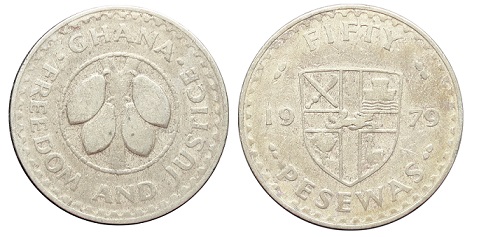
Worked example: Ama has one 50 pesewa coin, two 20 pesewa coins and one 10 pesewa coin. How much is that?
0.50 + 0.20 + 0.20 + 0.10 = GH₵1.00. One cedi exactly.
Try this: Find three different ways to make 1 cedi using coins. Then find two ways to make 70 pesewas.
19 / 41
The notes
Banknotes come in 1, 2, 5, 10, 20, 50, 100 and 200 cedis. Each note has its own colour, which makes them easy to tell apart.
Notes are whole cedis, so they go on the left of the decimal point. Coins fill in the pesewas on the right.

Worked example: Kofi has a 10 cedi note, a 5 cedi note, a 2 cedi coin and a 50 pesewa coin. How much is that?
10 + 5 + 2 + 0.50 = GH₵17.50.
Worked example: Abena needs GH₵36. Which notes could she use? A 20, a 10, a 5 and a 1. Or a 20 and a 10 and three 2 cedi coins.
Try this: Make GH₵48.50 using as few notes and coins as you can.
20 / 41
Writing money as a decimal
Money is written like a decimal with exactly two places after the point: GH₵ cedis . pesewas.
| Words | Written |
|---|---|
| four cedis | GH₵4.00 |
| four cedis fifty pesewas | GH₵4.50 |
| four cedis five pesewas | GH₵4.05 |
| fifty pesewas | GH₵0.50 |
| five pesewas | GH₵0.05 |
Notice the difference between GH₵4.50 and GH₵4.05. Fifty pesewas is ten times more than five pesewas. The zero holds the place.
Worked example: A trader writes a price as GH₵3.5. What does she mean? Three cedis and fifty pesewas, GH₵3.50. The missing zero is understood, but writing both digits is clearer.
Try this: Write in figures: twelve cedis twenty pesewas; seven cedis five pesewas; ninety pesewas; one hundred cedis.
21 / 41
Adding up a shopping list
At the market, adding prices is adding decimals. Line up the points and add.
Worked example: Ama buys tomatoes for GH₵6.50, onions for GH₵3.20 and pepper for GH₵2.80. What is the total?
   6.50
   3.20
+  2.80
-------
  12.50
Pesewas: 50 + 20 + 80 = 150 pesewas. That is 1 cedi and 50 pesewas. Write 50, carry 1 cedi. Cedis: 6 + 3 + 2 + 1 = 12. Total: GH₵12.50.

Notice that the pesewas column carried into the cedis column, exactly as hundredths carry into ones. Money follows the same rules as any other decimal.
Try this: Add up: bread GH₵8.00, eggs GH₵15.50, sugar GH₵4.75. Estimate first, then add carefully.
22 / 41
Adding money in your head
You do not always need paper. Here are two tricks.
Trick 1: Add the cedis, then the pesewas. GH₵4.20 + GH₵3.50. Cedis: 4 + 3 = 7. Pesewas: 20 + 50 = 70. Total GH₵7.70.
Trick 2: Make a whole cedi first. GH₵2.80 + GH₵1.50. Take 20 pesewas from the 1.50 and give it to the 2.80. Now it is GH₵3.00 + GH₵1.30 = GH₵4.30.
Worked example: Kwame buys a pencil for GH₵1.50 and an exercise book for GH₵4.50. Pesewas: 50 + 50 = 100, which is 1 cedi. Cedis: 1 + 4 + 1 = 6. Total GH₵6.00.
Worked example: GH₵9.90 + GH₵2.30. Think: 9.90 is 10 pesewas short of 10. Take 10 pesewas from 2.30: GH₵10.00 + GH₵2.20 = GH₵12.20.
Try this: In your head: GH₵5.40 + GH₵2.60; GH₵7.80 + GH₵1.30; GH₵12.50 + GH₵12.50.
23 / 41
Finding the change
Change is the money you get back when you pay more than the price. Change = money given − price. This is subtracting decimals.
Worked example: A loaf of bread costs GH₵7.50. Abena pays with a 10 cedi note.
  10.00
−  7.50
-------
   2.50
Change: GH₵2.50.
Worked example: Fried yam costs GH₵4.20. Kofi pays with a 5 cedi note. 5.00 − 4.20 = GH₵0.80, eighty pesewas.
Always check: price + change should equal what you paid. 4.20 + 0.80 = 5.00. Correct.
Try this: Find the change: price GH₵3.60, paid GH₵5. Price GH₵12.25, paid GH₵20. Price GH₵0.70, paid GH₵1.
24 / 41
Counting up to find change
Traders at the market rarely do written subtraction. They count up from the price to the money given, and hand over coins as they go.
Worked example: Price GH₵6.30. Paid with GH₵10.
- From 6.30, give 20 pesewas: now 6.50
- Give 50 pesewas: now 7.00
- Give three 1 cedi coins: now 10.00
Change given: 0.20 + 0.50 + 3.00 = GH₵3.70. Check: 10.00 − 6.30 = 3.70. Same.
Worked example: Price GH₵2.85. Paid with GH₵5.
- 2.85 + 0.05 = 2.90
- 2.90 + 0.10 = 3.00
- 3.00 + 2.00 = 5.00
Change: 0.05 + 0.10 + 2.00 = GH₵2.15.
Try this: Count up to find the change. Price GH₵4.40, paid GH₵5. Price GH₵13.75, paid GH₵20.
25 / 41
At Makola market
Ama's mother sends her to Makola market with a GH₵50 note and a list.

| Item | Price |
|---|---|
| Rice, 2 kg | GH₵24.00 |
| Palm oil | GH₵9.50 |
| Smoked fish | GH₵12.80 |
Step 1, the total: 24.00 + 9.50 + 12.80 = GH₵46.30.
Step 2, the change: 50.00 − 46.30 = GH₵3.70.
Step 3, check: 46.30 + 3.70 = 50.00. Correct.
Ama gets back a 2 cedi coin, a 1 cedi coin, a 50 pesewa coin and a 20 pesewa coin.
Try this: Ama's mother adds a bag of garden eggs for GH₵5.00. Is the GH₵50 still enough? What is the new change?
26 / 41
Is there enough money?
Before you buy, check that your money covers the price. Estimate to be quick, then calculate to be sure.
Worked example: Kofi has GH₵15. He wants a ball for GH₵9.90 and a drink for GH₵3.50. Can he afford both?
Estimate: 10 + 4 = 14, which is less than 15. Probably yes. Exact: 9.90 + 3.50 = 13.40. Yes, with GH₵1.60 to spare.
Worked example: Abena has GH₵20. She wants a book for GH₵14.75 and crayons for GH₵6.00. Estimate: 15 + 6 = 21. That is more than 20. Exact: 14.75 + 6.00 = 20.75. She is 75 pesewas short.

Try this: You have GH₵30. Kenkey GH₵8.00, fish GH₵15.50, pepper GH₵4.20, drink GH₵3.00. Which can you buy together?
27 / 41
How much is one?
Sometimes you know the price of several things and want the price of one. Share the money equally.
Worked example: 4 oranges cost GH₵6.00. What does one orange cost? 6.00 ÷ 4 = GH₵1.50.
Worked example: 10 sachets of water cost GH₵5.00. One sachet costs 5.00 ÷ 10 = GH₵0.50, fifty pesewas.
Dividing by 10 moves every digit one place to the right. GH₵5.00 becomes GH₵0.50. Dividing by 100 moves digits two places: GH₵5.00 becomes GH₵0.05.
Worked example: A pack of 5 pencils costs GH₵7.50. One pencil: 7.50 ÷ 5. Think of it as 750 pesewas ÷ 5 = 150 pesewas = GH₵1.50.
Try this: 2 exercise books cost GH₵9.00. What does one cost? 10 eggs cost GH₵25.00. What does one cost?
28 / 41
How much for many?
If you know the price of one, multiply to find the price of several.
Worked example: One meat pie costs GH₵3.50. How much are 3 pies?
Think in pesewas: 350 × 3 = 1050 pesewas = GH₵10.50.
Or add: 3.50 + 3.50 + 3.50 = 10.50.
Worked example: One sachet of water costs GH₵0.50. How much are 10 sachets? Multiplying by 10 moves every digit one place to the left: GH₵0.50 becomes GH₵5.00.
Worked example: Kwame buys 4 pens at GH₵2.25 each. 2.25 × 4: 2 × 4 = 8 cedis, 25 × 4 = 100 pesewas = 1 cedi. Total GH₵9.00.
Try this: One banana costs GH₵0.80. What do 5 bananas cost? One kilogram of rice costs GH₵12.50. What do 2 kilograms cost?
29 / 41
Saving up
Kofi wants a football that costs GH₵45.00. He saves part of his pocket money every week.
| Week | Saved this week | Total so far |
|---|---|---|
| 1 | GH₵8.50 | GH₵8.50 |
| 2 | GH₵10.00 | GH₵18.50 |
| 3 | GH₵7.25 | GH₵25.75 |
| 4 | GH₵9.75 | GH₵35.50 |
After four weeks he has GH₵35.50. How much more does he need?
45.00 − 35.50 = GH₵9.50.
If he saves GH₵9.50 or more in week 5, he can buy the ball.
Keeping a table like this is a good habit. Each row is one addition, and you can always see how far you have come.
Try this: Abena wants a schoolbag for GH₵60. She has saved GH₵22.40, GH₵15.60 and GH₵11.00. How much more does she need?
30 / 41
Decimals in measuring
Decimals are not only for money. We use them whenever we measure.
Length: Ama is 1.42 m tall. Her brother is 1.38 m. Who is taller, and by how much? 1.42 − 1.38 = 0.04 m, which is 4 cm. Ama is taller by 4 cm.
Mass: A bag of gari weighs 2.5 kg. Two bags weigh 2.5 + 2.5 = 5.0 kg.
Time: In a race, Yaw ran 100 m in 16.4 seconds and Kofi in 15.9 seconds. Kofi was faster by 16.4 − 15.9 = 0.5 seconds.
Temperature: A normal body temperature is about 37.0 degrees. Abena's is 38.6. That is 1.6 degrees higher, so she has a fever.
Try this: A bottle holds 1.5 litres. You pour out 0.75 litres. How much is left?
31 / 41
Decimals and the calculator
A calculator shows decimals with a dot. When you type 7.5 + 2.25 and press =, it shows 9.75.
But calculators drop the end zeros. If you type 4.50 + 3.50, it shows 8, not 8.00. For money, you must write the two pesewa digits yourself: GH₵8.00.
And 10 − 7.5 shows 2.5. As money that is GH₵2.50.
Worked example: Kwame types 3.6 + 2.4 and gets 6. Is that right? Yes. Six tenths plus four tenths is ten tenths, one whole. 3 + 2 + 1 = 6.
Worked example: The calculator shows 12.3 for a price. In cedis and pesewas that is GH₵12.30, twelve cedis thirty pesewas, not twelve cedis three pesewas.
Try this: Use a calculator to check three sums from earlier pages. Write each answer with two decimal places.
32 / 41
Common mistakes
Watch out for these. Everyone makes them at first.
Mistake 1: lining up the right-hand ends. Wrong: 12.5 + 3.25 written with the 5 under the 5. Right: line up the points. 12.50 + 3.25 = 15.75.
Mistake 2: thinking the longer decimal is bigger. 0.75 is not bigger than 0.8. Compare tenths first: 7 is less than 8.
Mistake 3: forgetting the zero. Three cedis five pesewas is GH₵3.05, not GH₵3.5.
Mistake 4: reading 0.25 as "zero point twenty-five". Say "zero point two five". Only money is read as "twenty-five pesewas".
Mistake 5: forgetting to carry pesewas. GH₵2.60 + GH₵1.70 is GH₵4.30, not GH₵3.130. One hundred pesewas becomes one cedi.
Try this: Find the mistake: 5.4 + 2.35 = 7.39.
33 / 41
Practice: place value
Try these on your own. Cover the answers with your hand.
- What is the 7 worth in 3.72?
- What is the 7 worth in 3.27?
- Write "six point zero eight" in figures.
- Write 45/100 as a decimal.
- Which is bigger: 2.09 or 2.1?
- Put in order, smallest first: 0.6, 0.56, 0.65, 0.5
- Round 18.5 to the nearest whole number.
Answers:
- 7 tenths, 0.7
- 7 hundredths, 0.07
- 6.08
- 0.45
- 2.1
- 0.5, 0.56, 0.6, 0.65
- 19
If you got any wrong, go back to the page about that idea and read it again. Then try a similar question of your own.
34 / 41
Practice: adding and subtracting
Work these out on paper. Line up the points.
- 4.6 + 3.2
- 7.85 + 1.4
- 9.07 + 0.95
- 8.5 − 2.3
- 6.4 − 1.75
- 20 − 13.6
- 0.9 + 0.1 + 0.35
Answers:
- 7.8
- 9.25
- 10.02
- 6.2
- 4.65
- 6.4
- 1.35
Check your working: For question 5, did you write 6.4 as 6.40 first? For question 6, did you write 20 as 20.0? For question 3, did you carry twice? If an answer is wrong, estimate it first and see whether your answer was even close.
35 / 41
Practice: money problems
- Ama buys kenkey for GH₵6.00 and fish for GH₵9.50. What does she pay?
- She pays with a 20 cedi note. What is her change?
- One sachet of water costs GH₵0.50. How much are 6 sachets?
- Kofi has GH₵12.30. He spends GH₵7.85. How much is left?
- 5 oranges cost GH₵4.00. What does one orange cost?
- Abena has two 2 cedi coins, three 50 pesewa coins and four 10 pesewa coins. How much is that?
Answers:
- GH₵15.50
- GH₵4.50
- GH₵3.00
- GH₵4.45
- GH₵0.80
- GH₵5.90
For question 4, write 12.30 − 7.85 with the points lined up and borrow twice. For question 6, add the coins in groups: the 2 cedi coins first, then the 50 pesewa coins, then the 10 pesewa coins.

36 / 41
A market game to play at home
Play this with a friend or your family. You need paper, a pencil and some pretend money. Cut paper into notes and coins, or use bottle tops for coins.
Set up: One person is the trader. Lay out five things, such as an orange, a pencil, a cup, a spoon and a book. Give each one a price with pesewas, like GH₵2.40 or GH₵7.85.
Play: The shopper picks two or three items and adds up the total out loud. The shopper then pays with a note that is bigger than the total. The trader counts up to find the change and hands it over.
Check: Both players write the subtraction on paper. If the change was wrong, the other player gets a point.
Swap roles after three turns. The player with more points wins.
Try this: Make one price end in 5 pesewas, like GH₵3.95. Does the change get harder? Then try paying with a 50 cedi note for a total under 10 cedis and see who can count up the fastest.
37 / 41
What you have learned
You started with oranges cut into pieces and finished with a shopping trip to Makola. Here is what you can now do:
- Read and write tenths and hundredths
- Use a place value table for decimals
- Compare and order decimals by looking at each place in turn
- Round decimals to the nearest whole number
- Add and subtract decimals by lining up the points
- Write money as GH₵ cedis.pesewas, always with two pesewa digits
- Add up a shopping list and find the change
- Count up to give change the way traders do
- Estimate first, so you can spot mistakes
Decimals are everywhere: on price tags, rulers, scales, clocks and thermometers. The next time you go to the market, work out the total and the change before the trader does. You will be surprised how often you are right.
38 / 41
Learn more
- Decimals at Maths is Fun — a clear page on tenths, hundredths and the decimal point, with practice questions
- Money at Maths is Fun — counting money, making change and money word problems
- BBC Bitesize: Decimals — short lessons and quizzes on decimal place value, adding and subtracting
- Khan Academy: Decimals — videos and exercises, from reading decimals to adding and subtracting them
- Bank of Ghana — the bank that issues Ghana's notes and coins
39 / 41
Watch more
40 / 41
Think about it
- Why do shops write GH₵4.50 and not GH₵4.5, when both mean the same amount?
- If a trader did not have any 5 pesewa coins, how would she give change for a price of GH₵2.95?
- Why is 0.9 bigger than 0.85, even though 85 is bigger than 9?
- Where else, apart from money, do you see decimals in a single day?
- Why is it a good idea to estimate before you add up a shopping list?
41 / 41
This book is for reading on SchoolSpec and cannot be printed.