Science
The Solar System
The solar system
The sun, the eight planets, how Earth spins and travels, the moon's phases, and why we have day, night and seasons.
Our place in space
Look up on a clear night at Bolgatanga or Cape Coast and you will see hundreds of stars. One of those points of light is not a star at all. It might be Venus, or Jupiter, or Mars: a planet, like our own Earth, travelling around the sun.
The solar system is the sun and everything that travels around it: eight planets, their moons, and millions of smaller rocks and lumps of ice. The word solar means "to do with the sun".
Earth is one of those eight planets. We live on a ball of rock, spinning as it moves through space, kept warm by a star ninety-three million miles away.
In this book you will learn what the solar system is made of, how its parts move, and why those movements give us day, night and seasons.
Try this: Tonight, look at the sky. Count how many stars you can see in one minute.

2 / 40
The sun is a star
The sun is not a planet. It is a star: a huge ball of burning gas that makes its own light and heat.
Stars at night look tiny because they are very, very far away. The sun looks big and bright because it is the closest star to us. It is still so far that its light takes about eight minutes to reach Earth.
Some sun facts:
- It is made mostly of hydrogen and helium gas.
- Its surface is about 5,500 °C. The centre is millions of degrees.
- More than a million Earths could fit inside it.
- It is about 4.6 billion years old.
Everything in the solar system travels around the sun because the sun is so heavy that its gravity pulls everything towards it.
Try this: Never look straight at the sun. Instead, notice how its light changes colour at sunrise and sunset. Why might that be?

3 / 40
Why the sun matters
Without the sun there would be no life on Earth.
Light. Plants use sunlight to make their food. Cassava, maize, cocoa and plantain all grow because of the sun. Animals eat plants, and we eat both.
Heat. The sun keeps Earth warm enough for water to stay liquid. Without it, the oceans would freeze solid.
Weather. The sun heats the land and the sea unevenly. That makes winds blow and water rise as vapour to form clouds and rain. The harmattan wind and the rainy season both begin with the sun.
Energy. Solar panels on rooftops in Ghana turn sunlight straight into electricity.
Try this: List five things you did today that would be impossible without the sun. Think carefully: even your breakfast counts.
4 / 40
What is a planet?
A planet is a large, round object that travels around a star and has cleared its path of other objects.
Planets do not make their own light. We see them because they reflect the sun's light, the same way the moon does.
Our solar system has eight planets. In order from the sun:
- Mercury
- Venus
- Earth
- Mars
- Jupiter
- Saturn
- Uranus
- Neptune
A sentence to remember the order: My Very Educated Mother Just Served Us Noodles.
Try this: Make up your own sentence using the first letters M, V, E, M, J, S, U, N. Make it funny so you remember it.
5 / 40
Two kinds of planet
The eight planets fall into two groups.
The inner planets (Mercury, Venus, Earth, Mars) are small and made of rock. You could stand on them. They are close to the sun and warm.
The outer planets (Jupiter, Saturn, Uranus, Neptune) are huge and made mostly of gas and ice. They have no solid surface to stand on. They are far from the sun and very cold. They are called the gas giants.
Between the two groups lies the asteroid belt, a ring of rocky lumps too small to be planets.
| Inner planets | Outer planets | |
|---|---|---|
| Made of | Rock | Gas and ice |
| Size | Small | Giant |
| Distance | Close to sun | Far from sun |
| Moons | Few or none | Many |
Try this: Which group does Earth belong to? Which planet is Earth's nearest neighbour?
6 / 40
Mercury
Mercury is the closest planet to the sun and the smallest of the eight. It is only a little bigger than our moon.
- It has no air to hold in heat, so the side facing the sun is roasting (over 400 °C) and the side facing away is freezing (below −170 °C).
- It is covered in craters from rocks crashing into it, just like the moon.
- It goes around the sun quickly, in only 88 Earth days. A year on Mercury is shorter than three months here.
- It has no moons.
Mercury is hard to see from Earth because it stays so close to the bright sun in the sky.
Try this: If you are 11 Earth years old, roughly how many Mercury years old are you? (Hint: there are about four Mercury years in one Earth year.)
7 / 40
Venus
Venus is the second planet from the sun. It is almost the same size as Earth, so people call it Earth's twin. But it is nothing like Earth.
- It is the hottest planet, about 465 °C, even hotter than Mercury. Its thick clouds of carbon dioxide trap the sun's heat like a blanket.
- The clouds are made of acid.
- The air presses down ninety times harder than on Earth.
- It spins backwards compared to most planets, and very slowly. One day on Venus is longer than its year.
Venus is the brightest thing in our sky after the sun and moon. You may have seen it low in the west after sunset, or in the east before dawn. People call it the "evening star" or "morning star", but it is a planet.
Try this: Look for Venus just after sunset this week. It does not twinkle like a star.
8 / 40
Earth
Earth is the third planet from the sun, and the only place we know of where there is life.
Why is Earth special?
- It is at the right distance from the sun: not too hot, not too cold. Scientists call this the "Goldilocks zone".
- It has liquid water. About 70% of its surface is ocean.
- It has air we can breathe, with oxygen made by plants.
- It has a magnetic field that shields us from harmful rays.
Earth is about 12,700 km across. It is not a perfect sphere; it bulges slightly at the middle. It has one moon.
From space, Earth looks blue (oceans), white (clouds), green and brown (land). Can you find Ghana on the picture? Look for the bulge of West Africa.
Try this: Find Ghana on a globe. Then find the equator. How close is Ghana to it?

9 / 40
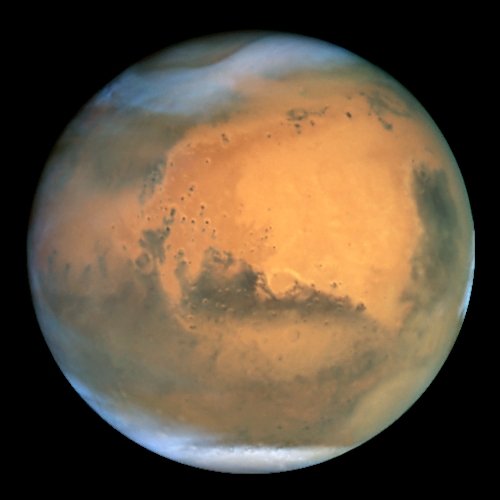
Mars
Mars is the fourth planet. It is called the Red Planet because its soil is full of rusty iron.
- It is about half the size of Earth.
- It is cold: about −60 °C on average.
- It has thin air, mostly carbon dioxide.
- It has the tallest volcano in the solar system, Olympus Mons, nearly three times the height of Mount Everest.
- It has two small moons, Phobos and Deimos.
- A day on Mars is only a little longer than ours: 24 hours and 37 minutes.
Robots called rovers have driven across Mars and sent back photographs. They found dry river beds, which means water once flowed there. One day people may visit.
Try this: Mars is sometimes visible as a reddish "star". Look for it in the night sky, or find a recent photograph from a Mars rover online.
10 / 40
Jupiter
Jupiter is the fifth planet and the largest by far. More than 1,300 Earths could fit inside it.
- It is a gas giant, made mostly of hydrogen and helium like the sun.
- Its bands of cloud are blown by winds faster than any on Earth.
- The Great Red Spot is a storm bigger than Earth that has been raging for hundreds of years.
- It has at least 95 moons. The four biggest, Io, Europa, Ganymede and Callisto, can be seen with a small telescope.
- It spins fast: a day on Jupiter is under 10 hours.
- A year on Jupiter is almost 12 Earth years.
Jupiter's strong gravity acts like a shield, pulling in rocks that might otherwise hit Earth.
Try this: If a day on Jupiter is 10 hours, how many Jupiter days are there in one Earth day (24 hours)? (About 2.4.)

11 / 40
Saturn
Saturn is the sixth planet. It is famous for its beautiful rings.
- The rings are made of billions of pieces of ice and rock, from tiny grains to lumps the size of a house.
- The rings are very wide (over 280,000 km across) but very thin, often less than a kilometre thick.
- Saturn is the second largest planet, another gas giant.
- It is so light for its size that it would float in a bathtub, if you could find one big enough.
- It has more than 140 moons. The largest, Titan, has a thick orange atmosphere.
- A year on Saturn is about 29 Earth years.
Saturn's rings can be seen through a small telescope. Many people say it is the most beautiful sight in the sky.
Try this: Draw Saturn with its rings. Remember the rings go around its middle, not its top.

12 / 40
Uranus and Neptune
The two farthest planets are so distant that they were not known until telescopes were invented.
Uranus is the seventh planet.
- It is a pale blue-green ice giant.
- It is tipped over on its side, so it rolls around the sun like a ball rather than spinning like a top.
- A year on Uranus is 84 Earth years.
- It has faint rings and 28 known moons.
Neptune is the eighth and last planet.
- It is deep blue and very windy, with the fastest winds in the solar system (over 2,000 km/h).
- It is so far from the sun that a year there is 165 Earth years. Nobody has lived a whole Neptune year.
- Its largest moon, Triton, travels backwards around it.
Both are bitterly cold, around −200 °C.
Try this: Neptune was discovered in 1846. Has it completed one full orbit since then? (Yes, just: one orbit was finished in 2011.)
13 / 40
What about Pluto?
For many years, children learned that there were nine planets. The ninth was Pluto, a small icy world beyond Neptune.
In 2006, scientists agreed on a clearer definition of a planet. A planet must:
- travel around the sun,
- be round, and
- have cleared its path of other objects.
Pluto passes the first two tests but not the third. Its path is crowded with other icy objects. So it was renamed a dwarf planet. There are other dwarf planets too, such as Ceres in the asteroid belt and Eris beyond Pluto.
Pluto did not change. Only the name changed. That is how science works: when we learn more, we update our ideas.
Try this: Explain to a parent or older relative why Pluto is no longer called a planet. They may have learned it the old way.
14 / 40
Sizes and distances
The solar system is mostly empty space. Pictures in books squeeze the planets together so they fit on the page.
Imagine the sun is a football placed at the centre of a football pitch in Accra.
- Earth would be a peppercorn about 23 metres away.
- Jupiter would be a small orange about 120 metres away, past the far goal.
- Neptune would be a pea about 700 metres away, outside the stadium.
And the next nearest star? On this scale, it would be in another country, thousands of kilometres away.
Light is the fastest thing there is. It takes 8 minutes from the sun to Earth, and over 4 hours to reach Neptune.
Try this: With a friend and a measuring tape, mark out the sun, Earth and Mars (35 metres) on your school field.
15 / 40
Gravity holds it together
Why do the planets not fly off into space? Gravity.
Gravity is a pull between all objects. The bigger and heavier an object, the stronger its pull. The sun is so heavy that its gravity reaches across billions of kilometres and holds every planet in its path.
But if the sun pulls the planets, why do they not fall into it? Because they are also moving sideways very fast. The sideways motion and the inward pull balance, so each planet keeps circling. Think of swinging a stone on a string: the string pulls inward, the stone moves around.
Gravity also:
- holds you onto the Earth,
- keeps the moon going around Earth,
- makes a dropped mango fall down, never up.
Try this: Tie a small stone to a string and swing it in a circle (outside, carefully). Feel the pull in the string. That pull is like gravity.
16 / 40
Earth spins: rotation
Earth is always moving in two ways at once. The first is rotation: Earth spins around an imaginary line through its centre, called its axis. The axis runs from the North Pole to the South Pole.
One full spin takes 24 hours. That is one day.
Earth spins from west to east. That is why the sun seems to rise in the east and set in the west. The sun is not moving across the sky; we are turning towards it, then away from it.
At the equator, which passes just south of Ghana, the ground is moving at about 1,600 km/h because of this spin. You do not feel it because everything around you, the air included, is moving with you.
Try this: Spin slowly on the spot in a room with one lamp. Notice how the lamp seems to move around you, though it is you who are turning.
17 / 40
Day and night
Rotation gives us day and night.
The sun lights up only one half of Earth at a time. The half facing the sun has day. The half facing away has night. As Earth spins, each place moves from the lit side to the dark side and back again.
When it is noon in Accra, with the sun high overhead, it is the middle of the night on the opposite side of the world, in the Pacific Ocean.
The line between day and night is called the terminator. From space you can see it as a soft edge between the bright and dark halves of Earth.
Because Earth spins towards the east, places to the east of Ghana (like Nigeria and Kenya) see the sunrise before we do.
Try this: Shine a torch on a ball in a dark room. Turn the ball slowly. Watch the lit half and the dark half change.

18 / 40
Time zones
Because Earth spins, the sun cannot be overhead everywhere at once. So the world is divided into time zones.
Ghana uses Greenwich Mean Time (GMT). The line of zero longitude, the Greenwich Meridian, passes through Tema. Ghana is one of the few countries that sits right on it.
When it is 12 noon in Accra:
- it is 1 pm in Lagos, Nigeria (one zone east),
- it is 3 pm in Nairobi, Kenya,
- it is 7 am in New York, USA (five zones west),
- it is 9 pm in Tokyo, Japan.
Each zone to the east is one hour later; each zone to the west is one hour earlier. There are 24 zones, one for each hour of the spin.
Try this: A cousin in London calls you at 6 pm London time in October, when London is on GMT+1. What time is it in Ghana?
19 / 40
Earth travels: orbit
Earth's second movement is its orbit (also called revolution): the journey around the sun.
One full orbit takes 365¼ days. That is one year.
The path is not a perfect circle but a slightly squashed one called an ellipse. Earth travels along it at about 107,000 km/h.
The extra quarter day is why we have a leap year. Every four years we add 29 February to catch up. 2024 was a leap year; 2028 will be the next.
Do not confuse the two movements:
- Rotation = spinning on the axis = 24 hours = day.
- Orbit = travelling around the sun = 365¼ days = year.
Earth does both at the same time, like a spinning top sliding across a table.
Try this: How many times does Earth rotate during one orbit? (About 365.)
20 / 40
Earth is tilted
Here is a fact that explains the seasons. Earth's axis is not straight up and down. It leans over by about 23.5 degrees.
As Earth travels around the sun, the axis always points the same way in space (towards the North Star). So for part of the year, the northern half of Earth leans towards the sun. Six months later, the southern half leans towards it.
The half leaning towards the sun gets:
- the sun higher in the sky,
- longer days,
- more direct, concentrated sunlight.
That half has summer. The other half, leaning away, has winter.
Try this: Hold a torch straight above a page and look at the bright circle. Now tilt the torch. The same light spreads over a bigger area and is weaker. That is the tilt effect.
21 / 40
The four seasons
Countries far from the equator, like Britain, Canada and South Africa, have four seasons:
- Spring: days growing longer, plants grow.
- Summer: longest days, warmest weather.
- Autumn: days shortening, leaves fall.
- Winter: shortest days, cold, sometimes snow.
The seasons are opposite in the two halves of the world. When it is summer in London (June, July, August), it is winter in Cape Town. When Ghanaian students in Canada are shivering in January, those in Australia are at the beach.
Remember: seasons are caused by the tilt, not by Earth being closer to or farther from the sun. In fact, Earth is slightly closest to the sun in January, when the north has winter.
Try this: Your friend says "It is summer because Earth is nearer the sun." What would you say to correct them?
22 / 40
Seasons in Ghana
Ghana is close to the equator, so the sun is high in the sky all year. We do not get a real summer and winter. Instead we have a rainy season and a dry season.
In the south (Accra, Kumasi, Takoradi):
- Major rainy season: April to July.
- Short dry spell: August.
- Minor rainy season: September to November.
- Dry season: December to March, with the harmattan, a dry dusty wind from the Sahara.
In the north (Tamale, Bolgatanga):
- One rainy season: May to October.
- One long dry season: November to April.
These seasons are driven by the sun too. As the sun moves north and south through the year, it drags the belt of rain with it.
Try this: Which season is it now where you live? What signs tell you?
23 / 40
Day length and the equator
Near the equator, days and nights are almost the same length all year: about 12 hours each. In Accra, the sun rises close to 6 am and sets close to 6 pm every month.
Far from the equator it is different. In London in June the sun rises before 5 am and sets after 9 pm: about 16 hours of daylight. In December it is only 8 hours.
At the North Pole, the sun does not set at all for six months in summer, and does not rise for six months in winter.
This happens because of the tilt. Ghana, being near the middle, is barely affected. We get steady days all year.
Try this: For one week, note the time the sun sets. Does it change? Compare with what a pen-pal in Europe would see.
24 / 40
The moon
The moon is Earth's only natural satellite: an object that travels around a planet.
- It is about 3,500 km across, a quarter of Earth's width.
- It is about 384,000 km away. Light from it takes just over a second to reach us.
- It has no air, no water on its surface and no weather. Footprints left there in 1969 are still there.
- Its surface is covered in craters, dark flat plains called "seas" (though they are dry), and mountains.
- Its gravity is one sixth of Earth's. You could jump six times higher there.
The moon makes no light of its own. It shines because it reflects sunlight.
Try this: Look at the full moon. Can you see the dark patches? People in different countries see different shapes in them: a face, a rabbit, a woman carrying wood.
25 / 40
The moon goes around Earth
The moon orbits Earth once every 27.3 days. From one full moon to the next is about 29.5 days, close to a month. In fact the word month comes from moon.
The moon also rotates, but it takes exactly as long to spin once as to go around Earth once. The result: the moon always shows us the same face. Nobody saw the far side of the moon until a spacecraft flew around it in 1959.
The moon's gravity pulls on Earth's oceans and causes the tides. At Elmina or Ada, the sea rises and falls twice a day because of the moon.
Try this: Walk slowly in a circle around a friend, always facing them. Your friend only ever sees your face, never your back. That is what the moon does.
26 / 40
Phases of the moon
The moon seems to change shape over the month. These shapes are called phases.
The moon does not really change shape. We see different amounts of its sunlit half as it travels around us.
The main phases, in order:
- New moon: the lit side faces away from us. We see nothing.
- Crescent: a thin slice.
- First quarter: half lit (the right half, seen from Ghana).
- Gibbous: more than half.
- Full moon: the whole lit side faces us.
- Then gibbous, last quarter (left half lit), crescent, and back to new.
From new to full, the moon is waxing (growing). From full to new, it is waning (shrinking).
Try this: Draw the moon every night for two weeks. Label each drawing with its phase.

27 / 40
Eclipses
Sometimes the sun, Earth and moon line up exactly. Then we get an eclipse.
Solar eclipse: the moon passes between the sun and Earth, and its shadow falls on part of Earth. The sky goes dark in the daytime. Ghana saw a total solar eclipse on 29 March 2006, and crowds gathered in Cape Coast to watch.
Lunar eclipse: Earth passes between the sun and moon, and Earth's shadow falls on the moon. The full moon turns a dim copper-red colour.
Eclipses do not happen every month because the moon's path is slightly tilted, so most months it passes just above or below the line.
Safety: never look at the sun during a solar eclipse without proper eclipse glasses. Ordinary sunglasses are not enough. A lunar eclipse is safe to watch.
Try this: Use a ball (moon), a bigger ball (Earth) and a torch (sun). Arrange them to make each kind of eclipse.
28 / 40
Visiting the moon
The moon is the only other world humans have stood on.
In July 1969, the American spacecraft Apollo 11 landed there. Neil Armstrong and Buzz Aldrin walked on the surface for over two hours, collected rocks and planted a flag, while Michael Collins stayed in orbit. Twelve people in all walked on the moon between 1969 and 1972.
The journey took about three days each way.
Why go? To learn how the moon formed (most scientists now think a huge object hit the young Earth and the pieces became the moon), to test spacecraft, and because exploring is part of being human.
New missions are planning to return, and some hope to build a base there.
Try this: If you could take one thing from Ghana to leave on the moon, what would it be and why?
29 / 40
Comets, asteroids and meteors
The solar system contains more than planets and moons.
Asteroids are lumps of rock, mostly in the asteroid belt between Mars and Jupiter. Some are a few metres wide; the largest, Ceres, is nearly 1,000 km.
Comets are balls of ice and dust from the cold outer edges. When one comes near the sun, the ice turns to gas and streams out as a glowing tail millions of kilometres long.
Meteors are tiny bits of rock or dust that burn up as they enter Earth's air, making a streak of light. People call them "shooting stars", but they are not stars. If a piece survives and hits the ground, it is a meteorite.
Try this: On a dark night away from town lights, lie back and watch the sky for twenty minutes. You will probably see a meteor.
30 / 40
Studying the sky
How do we know all this? People have been studying the sky for thousands of years.
- Ancient farmers in Ghana and across Africa used the stars and moon to know when to plant and harvest.
- Telescopes, invented about 400 years ago, showed Jupiter's moons and Saturn's rings.
- Space probes have now flown past or landed on every planet. Voyager 2 visited all four gas giants.
- The Hubble Space Telescope orbits Earth and takes sharp pictures with no air in the way.
- Ghana has its own radio telescope at Kuntunse, near Accra, which listens to signals from space.
Scientists who study space are called astronomers. Some of them started by looking up as children, just like you.
Try this: Find out what the Ghana Radio Astronomy Observatory at Kuntunse does.
31 / 40
Living in space
Astronauts live for months on the International Space Station, which orbits Earth every 90 minutes at 28,000 km/h. They see 16 sunrises a day.
In orbit, everything floats, because the station and everyone in it are falling around Earth together. Astronauts:
- sleep in bags strapped to the wall,
- drink water through straws from pouches,
- exercise two hours a day so their muscles and bones stay strong,
- grow lettuce and other plants in special boxes.
There is no air outside, so to go out they wear a spacesuit that carries its own air, keeps them warm or cool, and protects them from the sun's harmful rays.
Try this: Design a breakfast for an astronaut. Remember: crumbs float and can get into machines, and liquids form floating balls.
32 / 40
Is there life elsewhere?
Earth is the only place we know of with life. But the universe is enormous. Our sun is one of hundreds of billions of stars in our galaxy, the Milky Way, and there are billions of galaxies.
Astronomers have found thousands of exoplanets: planets going around other stars. Some are rocky and at the right distance from their star for liquid water.
Within our own solar system, scientists are looking closely at:
- Mars, which had rivers and lakes long ago,
- Europa, a moon of Jupiter with an ocean under its ice,
- Enceladus, a moon of Saturn that sprays water into space.
Nobody has found life yet. But nobody has proved it is not there, either.
Try this: If you could send one message to another world, what would you say? Keep it to twenty words.
33 / 40
Space and Ghana
Space science is not only for big countries.
- Ghana launched its first satellite, GhanaSat-1, in 2017. It was built by students at All Nations University in Koforidua and sent to the International Space Station, then released into orbit.
- The Ghana Space Science and Technology Institute trains scientists and uses satellite pictures to watch floods, farms and illegal mining.
- The radio telescope at Kuntunse was converted from an old telecommunications dish.
- Satellites help Ghana with weather forecasts, mobile phone signals, TV, and the GPS maps on phones.
A pupil in Basic 6 today could be building Ghana's next satellite in fifteen years.
Try this: Look up GhanaSat-1. What was it designed to do?
34 / 40
Common mistakes
Let us clear up ideas that many people get wrong.
- "The sun goes around the Earth." No. Earth spins, which makes the sun seem to move across the sky.
- "Seasons happen because Earth gets closer to the sun." No. They happen because of Earth's tilt.
- "The moon makes its own light." No. It reflects sunlight.
- "The moon's phases are caused by Earth's shadow." No. That is an eclipse, which is rare. Phases are caused by the angle we see the moon's lit half from.
- "Shooting stars are stars." No. They are tiny bits of rock burning up in our air.
- "There is no gravity in space." There is. Astronauts float because they are falling around Earth.
Try this: Choose one of these and explain the correct idea to a younger pupil.
35 / 40
Quick check
Answer these from memory, then check below.
- What is the sun: a planet or a star?
- Name the eight planets in order.
- Which planet is largest? Which is hottest?
- What is one rotation of Earth called, and how long does it take?
- What is one orbit of Earth called, and how long does it take?
- What causes the seasons?
- Why does the moon seem to change shape?
- How many moons does Earth have?
Answers: 1. A star. 2. Mercury, Venus, Earth, Mars, Jupiter, Saturn, Uranus, Neptune. 3. Jupiter; Venus. 4. A day; 24 hours. 5. A year; 365¼ days. 6. The tilt of Earth's axis. 7. We see different amounts of its sunlit half as it orbits us. 8. One.
36 / 40
Summary
- The sun is a star at the centre of the solar system. Its gravity holds everything in orbit.
- Eight planets circle it: four small rocky inner planets, four giant gas and ice outer planets.
- Earth is third from the sun and the only known home of life.
- Rotation: Earth spins once in 24 hours, giving day and night.
- Orbit: Earth circles the sun once in 365¼ days, giving the year.
- Earth's tilt of 23.5° gives the seasons. Near the equator, Ghana has rainy and dry seasons instead.
- The moon orbits Earth in about a month. Its phases show how much of its lit half we see.
- Planets and the moon reflect sunlight; they do not make their own.
37 / 40
Learn more
- NASA Science: Solar System — facts, photographs and news about every planet
- NASA Space Place — NASA's site for young learners, with activities and simple explanations
- ESA Kids: The Solar System — the European Space Agency's pages for children
- NASA Solar System Exploration — detailed pages on planets, moons and missions
38 / 40
Watch more
39 / 40
Think about it
- If Earth spun twice as fast, how would a day be different? What might change for plants, animals and people?
- If Earth's axis were not tilted at all, would there be seasons anywhere? What would Ghana's weather be like?
- Why do you think people long ago believed the sun went around the Earth?
- Which planet would you most like to visit, and what one problem would you have to solve to survive there?
- Pluto was called a planet for 76 years and then renamed. Is it a good thing that science changes its mind? Why?
40 / 40
This book is for reading on SchoolSpec and cannot be printed.