Social Studies
Ghana's Natural Resources
Ghana's natural resources
Gold, cocoa, oil, timber, water and land: where Ghana's riches are found, how they are used, who they help, and how we must look after them.
What is a natural resource?
A natural resource is anything found in nature that people can use. Nobody made it; it was already there. We only find it, collect it and put it to work.
Ghana is rich in natural resources. Under the ground there is gold, bauxite, manganese and diamonds. Under the sea there is oil and gas. On the land there are forests full of timber, rivers and lakes full of water and fish, and fertile soil where cocoa, maize, yam and cassava grow.
These resources feed us, give us jobs, light our homes and earn money for the country when they are sold abroad.
In this book we will look at six of the most important: gold, cocoa, oil, timber, water and land. For each one we ask: where is it, how is it used, and how do we care for it?
Try this: Look around your home. Name three things made from something that came out of the ground, the forest or the sea.
2 / 39
Renewable or not?
Natural resources come in two kinds.
Renewable resources can grow back or be replaced if we use them carefully. Trees grow again. Rain fills the rivers. Cocoa trees fruit every year. Fish breed. Sunlight returns every morning.
Non-renewable resources cannot be replaced. Once we dig up a lump of gold or pump out a barrel of oil, it is gone. The Earth took millions of years to make it, and will not make more in our lifetime.
| Renewable | Non-renewable |
|---|---|
| Timber, cocoa, water, fish, soil, sunlight | Gold, oil, gas, bauxite, diamonds |
This matters. A renewable resource can last forever if we use it no faster than it grows back. A non-renewable one must be used wisely, because when it is finished, it is finished.
Try this: Sort these into the two groups: charcoal, salt, mangoes, manganese, wind.
3 / 39
Ghana's regions and their riches
Ghana has 16 regions, and the resources are not spread evenly.
- Western and Western North: gold, cocoa, timber, oil off the coast, manganese and bauxite.
- Ashanti: gold (Obuasi), cocoa, timber.
- Eastern: cocoa, bauxite, diamonds (Akwatia), the Akosombo Dam.
- Central: cocoa, fishing, Kakum forest.
- Ahafo, Bono, Bono East: cocoa, gold, timber, cashew.
- Volta and Oti: Lake Volta, fishing, farming.
- Northern, Savannah, North East, Upper East, Upper West: maize, rice, yam, shea nuts, cattle.
- Greater Accra: the ports of Tema and the Greenwich Meridian; salt at Ada.
The forest zone in the south grows cocoa and timber. The savannah in the north grows grain and livestock. Gold runs in a belt through the south-west.
Try this: Find your own region on a map. Which resources does it have?
4 / 39
Gold: Ghana's oldest treasure
Long before Europeans arrived, the people of this land were mining and trading gold. The kings of the Asante wore gold; their stools were covered in it. Traders carried it north across the Sahara.
When Europeans came in the 1400s, they saw so much gold that they named the whole coast the Gold Coast. That remained the country's name until independence in 1957, when it became Ghana.
Today Ghana is the largest gold producer in Africa and one of the top ten in the world.
Gold is found in a belt running through the south-west of the country, in rocks that are more than two billion years old.
Try this: Look at the Ghana flag. The black star sits on a gold stripe. Why do you think gold was chosen?
5 / 39
Where gold is mined
The main gold-mining towns are:
- Obuasi (Ashanti Region): one of the richest gold mines in the world, mined for over a hundred years.
- Tarkwa and Prestea (Western Region): large open-pit mines.
- Ahafo (Ahafo Region): a newer, very large mine near Kenyasi.
- Damang, Bibiani, Chirano and others.
There are two ways to mine gold.
Underground mining: shafts and tunnels dug deep into the rock, as at Obuasi, where tunnels go more than a kilometre down.
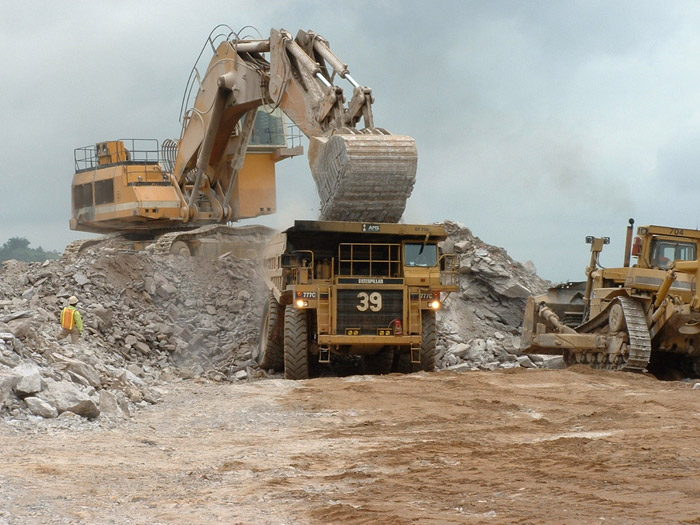
Open-pit mining: a huge hole dug from the surface, layer by layer, as at Tarkwa. Enormous trucks carry the rock to a plant where the gold is separated out.
Try this: Which would be more dangerous for the miners: underground or open-pit? Which does more damage to the land above?
6 / 39
How gold is used
Gold is soft, shiny, never rusts and is easy to shape. Those qualities make it precious.
- Jewellery: rings, chains, earrings. The goldsmiths of Kumasi are famous for their work.
- Money and savings: banks and governments keep bars of gold as a store of wealth. When Ghana sells gold abroad, it earns foreign money (dollars) to buy things the country needs.
- Electronics: tiny amounts of gold are inside every mobile phone and computer, because it carries electricity well and does not corrode.
- Medicine and dentistry: gold fillings for teeth; gold in some medicines.
- Ceremony: chiefs' regalia, the Golden Stool of the Asante.
Gold is Ghana's biggest export (something sold to other countries). It brings in more money than cocoa or oil.
Try this: Find out today's price of one ounce of gold. How many cedis is it?
7 / 39
The problem of galamsey
Galamsey comes from the words "gather them and sell". It means illegal small-scale mining: digging for gold without a licence, often with no care for the land or water.
Galamsey has caused serious harm:
- Rivers poisoned. Miners use mercury and other chemicals to separate gold. These wash into rivers like the Pra, Ankobra, Offin and Birim, which turn brown and muddy. Fish die. Water companies struggle to make the water safe to drink.
- Farmland destroyed. Cocoa farms are dug up and left as pits full of dirty water.
- Forests cleared.
- Deaths. Pits collapse on miners, including children who should be in school.
The government has sent soldiers to stop galamsey and has banned mining in rivers. But people keep doing it because they are poor and gold is valuable.
Try this: Why might someone do galamsey even though it is illegal and dangerous? What could help them stop?

8 / 39
Mining responsibly
Mining does not have to destroy. A responsible mine:
- gets a licence and follows the rules,
- keeps chemicals out of rivers,
- fills in pits and replants trees when it is finished (this is called reclamation),
- pays taxes and royalties to the government and the local community,
- employs local people and trains them,
- keeps children out of the mine and in school.
The Minerals Commission gives licences and checks mines. The Environmental Protection Agency (EPA) checks for pollution.
Small-scale mining can be legal too. Ghanaians can form groups, get a licence and mine a small area properly. The problem is not small mining; it is careless, illegal mining.
Try this: Imagine you own a small gold mine. Write three rules for your workers that protect the river nearby.
9 / 39
Cocoa: the golden pod
Cocoa is the seed of a tree that grows in the warm, wet forest zone of Ghana. Chocolate is made from it.
The tree is not native to Ghana. In 1879 a blacksmith called Tetteh Quarshie brought cocoa beans from Fernando Po (now part of Equatorial Guinea) and planted them at Mampong-Akuapem. From that small farm, cocoa spread across the forest zone.
By the 1920s, the Gold Coast was the world's biggest cocoa producer. Today Ghana is second in the world, after neighbouring Côte d'Ivoire. Together the two countries grow about 60% of the world's cocoa.
Nearly one million Ghanaian families grow cocoa on small farms. For many villages, cocoa is life.
Try this: Ask an older relative whether anyone in your family has ever grown cocoa.

10 / 39
Where cocoa grows
Cocoa needs heat, rain and shade. It grows best under taller forest trees, in deep soil, where it rains most of the year. That means the forest zone of southern Ghana.
The main cocoa regions are:
- Western North and Western (the biggest producers today)
- Ashanti
- Ahafo and Bono
- Eastern
- Central
- Volta (a smaller amount)
Cocoa does not grow in the dry north; it is too hot and dry there. Nor does it grow well right on the coast.
A cocoa farm is usually small, a few acres, owned by a family. The trees take about three to five years to give their first pods, then produce for twenty-five years or more.
Try this: Why does cocoa not grow in Tamale? Give two reasons.
11 / 39
From pod to chocolate
Cocoa pods grow straight out of the trunk and branches. Each pod holds 30 to 50 beans in sweet white pulp.
- Harvest: pods are cut from the tree with a cutlass or a hooked knife on a pole, twice a year (main crop October to February, light crop May to August).
- Breaking: pods are split open and the wet beans scooped out.
- Fermenting: beans are heaped under banana leaves for about six days. This gives them the chocolate flavour.
- Drying: beans are spread on raised mats in the sun for a week or two, turned often.
- Bagging: dry beans go into sacks and are sold to a buying company.
- Export or factory: most beans are shipped from Tema or Takoradi. Some are made into chocolate in Ghana, at factories in Tema.
Try this: Which of these steps happens on the farm, and which happens in a factory?

12 / 39
COCOBOD and the farmer
The Ghana Cocoa Board (COCOBOD) is the government body in charge of cocoa. It:
- sets the price farmers are paid each season, so that farmers know what they will get,
- checks the quality of beans before export (Ghana's cocoa is known as the best quality in the world),
- gives farmers seedlings, fertiliser and sprays against pests,
- researches better trees at the Cocoa Research Institute at Tafo.
The money from cocoa pays for schools, roads and clinics in cocoa villages. The famous Cocoa Clinic in Accra was built with cocoa money.
But farmers face problems: old trees, diseases like swollen shoot, low prices, and young people leaving for the cities. Some farms have even been sold to galamsey miners.
Try this: If you were head of COCOBOD, what one thing would you do to help cocoa farmers?
13 / 39
Oil: Ghana's newest resource
For many years people searched for oil off Ghana's coast and found little. Then in 2007, a huge field was discovered under the sea about 60 km from the Western Region coast. It was named Jubilee, because Ghana was celebrating 50 years of independence.
Oil started flowing in December 2010. Since then, more fields have been found nearby: TEN (Tweneboa, Enyenra, Ntomme) and Sankofa.
Oil is a fossil fuel. It formed from tiny sea creatures that died millions of years ago, were buried under mud, and were slowly squeezed and heated into a thick black liquid. Natural gas is often found with it.
Oil is non-renewable. Ghana's fields may last a few decades.
Try this: Why do you think the first field was named Jubilee? What does the word mean?
14 / 39
How oil is produced and used
Ghana's oil lies deep under the seabed, so it is reached from a floating platform.
A giant ship called an FPSO (Floating Production, Storage and Offloading vessel) is anchored above the field. Pipes run down to wells drilled into the seabed. The ship pumps the oil up, separates it from gas and water, stores it, and loads it onto tankers.
Ghana's FPSOs are named after national heroes: Kwame Nkrumah, John Agyekum Kufuor and John Evans Atta Mills.
What is oil for?
- Petrol and diesel for cars, trotros, lorries and boats.
- Gas for cooking and for power stations that make electricity.
- Plastics, paints, fertiliser and road tar.
- Export: most of Ghana's crude oil is sold abroad.
The Ghana National Petroleum Corporation (GNPC) manages the country's share.
Try this: Name five things in your classroom that are made of plastic, and so come partly from oil.

15 / 39
Oil: blessing or curse?
Oil brings money, but it also brings risks. Some countries with lots of oil have stayed poor because the money was wasted or stolen. People call this the resource curse.
Ghana made rules to avoid it:
- The Petroleum Revenue Management Act says how oil money must be split: some for the budget now, some saved in a Heritage Fund for future generations, and some in a Stabilisation Fund for when prices fall.
- The Public Interest and Accountability Committee (PIAC) reports to the public on how the money is spent.
Other worries: an oil spill would poison fish and beaches; fishermen at Axim and Half Assini say the platforms have reduced their catch; and burning oil adds to climate change.
Try this: Should Ghana spend oil money now on schools and roads, or save it for the future? Give one reason for each side.
16 / 39
Timber: the forest's gift
Timber is wood cut from trees for building and making things. Ghana's forest zone has many valuable hardwood trees:
- Odum (iroko): strong, used for doors, furniture and canoes.
- Mahogany: reddish, beautiful, used for fine furniture.
- Wawa: light and soft, used for plywood and boxes.
- Sapele, emire, teak and others.
Timber is used for houses, school desks, chairs, doors, window frames, boats, drums, the carved stools of the Akan and the kente looms of Bonwire. Much is also exported.
The main timber areas are the Western, Western North, Ashanti, Ahafo and Eastern regions. Sawmills in Kumasi and Takoradi cut logs into planks.
Try this: Count the wooden things in your classroom. What kinds of wood might they be?

17 / 39
The shrinking forest
A hundred years ago, thick forest covered most of southern Ghana. Today less than a quarter of it is left.
Why has the forest shrunk?
- Logging for timber, some of it illegal, taking trees faster than they grow.
- Farming: clearing forest to plant cocoa and food crops.
- Charcoal and firewood: most Ghanaian homes still cook with wood or charcoal.
- Mining, including galamsey.
- Bush fires, especially in the dry season.
- Towns growing outwards.
Losing forest is a serious problem. Forests hold the soil together, soak up rain, keep rivers flowing in the dry season, give homes to animals and provide medicine, bushmeat and snails. They also take in carbon dioxide, helping to slow climate change.
Try this: What do you cook with at home? If it is charcoal, where does that charcoal come from?
18 / 39
Protecting the forest
Ghana has forest reserves where logging is controlled, and national parks where it is banned altogether. Famous ones include Kakum (Central Region), Mole (Savannah Region), Ankasa (Western) and Bia (Western North).
The Forestry Commission looks after these and gives permits for cutting timber. The rules say loggers must:
- cut only trees above a certain size,
- leave enough trees standing,
- plant new trees to replace those taken.
Every June, Ghana holds Green Ghana Day, when millions of seedlings are planted by schools, churches and companies.
You can help: plant a tree, use less charcoal (a more efficient stove uses half as much), and never start bush fires.
Try this: Plant a seed from a fruit you eat (mango, orange, avocado) in a tin of soil. Water it and watch it grow.
19 / 39
Water: rivers and lakes
Water is a resource we cannot live without. Ghana is fortunate to have many rivers and the largest man-made lake in the world.
Main rivers:
- The Volta and its branches: the Black Volta, White Volta and Oti, which flow from the north into Lake Volta and on to the sea at Ada.
- The Pra, Ankobra, Tano and Birim in the south-west.
- The Densu, which supplies Accra from the Weija Dam.
Lake Volta was created in 1965 when the Akosombo Dam blocked the Volta River. It stretches more than 400 km from Akosombo almost to Yeji, and covers nearly 4% of Ghana's land. Lake Bosomtwe, near Kumasi, is Ghana's only natural lake, formed by a meteorite.
Try this: Which river is nearest your school? Where does it start and where does it end?
20 / 39
How water is used
Every drop of water does work.
- Drinking and washing. Water companies take water from rivers and dams, clean it and pipe it to towns. Many villages use boreholes and wells.
- Farming. Irrigation projects such as Tono and Vea in the Upper East and the Kpong scheme let farmers grow rice and vegetables in the dry season.
- Fishing. Lake Volta provides a large share of Ghana's freshwater fish, including tilapia, and gives work to thousands of fishing families.
- Transport. Boats carry people, yams and goods up and down Lake Volta from Akosombo to Yeji.
- Electricity. The biggest use of all, on the next page.
Water is renewable: rain fills the rivers each year. But a river can still be ruined by pollution, or dry up if its forest is cut.
Try this: Keep a tally of every time your family uses water in one day.

21 / 39
Akosombo: water into light
In 1961, Ghana's first president, Kwame Nkrumah, began building a great dam across the Volta River at Akosombo. It was finished in 1965.
The dam holds back the river to form Lake Volta. Water rushes through tunnels in the dam and spins huge turbines, which turn generators that make electricity. This is called hydroelectric power ("hydro" means water).
Akosombo, with the smaller Kpong dam downstream and the Bui dam on the Black Volta, supplies a large part of Ghana's electricity. The Volta River Authority (VRA) runs them.
The dam had a cost. About 80,000 people had to leave their homes as the lake filled and were resettled in new villages.
When the rains fail and the lake is low, Ghana gets less power. That is one cause of "dumsor".
Try this: Where does the electricity in your home come from? Find out if your area is supplied by hydro or by gas power stations.

22 / 39
Caring for water
Clean water is becoming harder to find in Ghana. The main threats:
- Galamsey mud and mercury in the Pra, Ankobra, Birim and Offin.
- Rubbish and sewage in streams and lagoons, like the Korle Lagoon in Accra.
- Chemicals from farms washing into rivers.
- Cutting forests along river banks, so rivers silt up and dry out in the harmattan.
- Over-fishing with tiny nets or chemicals that kill everything.
What can be done?
- Keep a strip of trees along every river (a buffer zone).
- Never throw rubbish into gutters; it ends in the sea.
- Report galamsey.
- Use water carefully: turn taps off, mend leaks.
Try this: Walk to the nearest stream or gutter. What do you see in the water? Where will it go when it rains?
23 / 39
Land: the resource under our feet
Land is the resource all the others sit on. Ghana has about 238,000 square kilometres of it, and it is used in many ways:
- Farming: more than half of Ghanaians work on the land. Food crops (maize, cassava, yam, plantain, rice, millet, sorghum) and cash crops (cocoa, oil palm, cashew, shea, rubber, cotton).
- Grazing: cattle, sheep and goats, especially in the north.
- Building: homes, schools, roads, markets, factories.
- Mining and forests.
- Sacred groves and burial grounds, protected by custom.
Ghana's soil varies. The forest zone has deep, rich soil. The northern savannah has thinner soil that must be rested and fed. The coastal plain is sandy and dry.
Try this: Draw a map of the area around your school. Colour the land by how it is used: homes, farms, roads, bush.
24 / 39
Who owns the land?
In Ghana, most land is not owned by the government. About 80% is held by stools and skins (chiefs, on behalf of their people), families and clans. The chief or family head is a custodian: he holds the land in trust for those alive, those dead and those not yet born.
A famous saying from the Akan puts it this way: "Land belongs to a vast family of which many are dead, few are living, and countless members are still unborn."
This means land cannot simply be sold like a bicycle. Decisions must consider the future.
The government owns some land (for roads, schools, forest reserves) and can take land for public use, but must pay for it.
Today, as towns grow, there are many disputes over land. The Lands Commission keeps records to help settle them.
Try this: Ask who holds the land your school stands on.
25 / 39
Caring for the land
Land can be worn out. Soil erosion happens when rain or wind carries away the top layer of soil, the part with the goodness in it. Bare, over-farmed or over-grazed land erodes fastest. In the north, the Sahara creeps south a little each year: this is desertification.
Farmers protect their land by:
- Crop rotation: growing different crops each year so the soil is not used up.
- Fallow: resting a field for a season.
- Mulching: covering the soil with leaves to keep moisture and stop erosion.
- Planting trees as windbreaks and along slopes.
- Not burning the bush, which kills the soil's life.
- Compost and manure instead of only chemical fertiliser.
Try this: Fill two trays with soil. Cover one with grass or leaves and leave the other bare. Pour the same cup of water over each from a height. Which one loses more soil?
26 / 39
Other resources: minerals
Gold is not the only treasure in Ghana's rocks.
- Bauxite (the ore of aluminium): at Awaso (Western North), the Atewa range (Eastern) and Nyinahin (Ashanti). The aluminium smelter at Tema (VALCO) was built to use it.
- Manganese (used in steel): at Nsuta near Tarkwa. Ghana is a leading producer.
- Diamonds: at Akwatia on the Birim River, mostly small industrial stones.
- Limestone for cement at Buipe and Nauli; salt from the lagoons at Ada, Keta and Elmina; clay for bricks and pots; sand and gravel for building.
Mining bauxite in the Atewa forest is a hot debate: the forest is also the source of three rivers that supply water to millions, including Accra.
Try this: Which is more valuable to Ghana: the bauxite under the Atewa forest, or the water that flows from it? Discuss.
27 / 39
Other resources: the sea
Ghana's coastline is about 550 km long, from Half Assini to Aflao. The sea is a resource in its own right.
- Fish. Fishing villages all along the coast (Elmina, Winneba, Jamestown, Tema, Keta) send out canoes for tuna, sardines (herrings) and mackerel. Smoked fish from the coast feeds the whole country.
- Salt. Sea water is dried in pans at Ada and Keta.
- Ports. Tema and Takoradi harbours handle almost all of Ghana's imports and exports: cocoa and timber out, cars and machinery in.
- Tourism. Beaches at Busua, Kokrobite and Ada draw visitors.
- Oil and gas beneath the seabed.
Threats: over-fishing by large foreign trawlers, "light fishing" with lamps that scoop up young fish, plastic waste, and erosion eating the coast at Keta.
Try this: Where does the fish your family eats come from: the sea, Lake Volta or a fish farm?
28 / 39
Resources and jobs
Natural resources give Ghanaians work.
- Cocoa: about a million farming families, plus buyers, drivers, port workers.
- Gold: tens of thousands in large mines, many more in small-scale mining.
- Fishing: over two million people depend on it, including the women who smoke and sell the fish.
- Timber: loggers, sawmill workers, carpenters, carvers.
- Oil: engineers, divers, cooks and sailors on the FPSOs, though fewer jobs than people hoped.
- Farming: more than any other kind of work.
Resources also create indirect jobs. A cocoa village needs teachers, nurses, mechanics and traders, all paid, in the end, by cocoa money.
Try this: List the jobs of five adults you know. Which natural resource does each job depend on, even indirectly?
29 / 39
Resources and exports
When Ghana sells resources to other countries, it earns foreign exchange (dollars, euros, pounds). The country needs this money to buy what it cannot make: medicines, vehicles, machines, fuel, rice.
Ghana's top exports, roughly in order of value:
- Gold
- Oil
- Cocoa beans and cocoa products
- Timber and wood products
- Manganese, bauxite, cashew, fish, fruit
Notice that most of these are sold raw. Ghana sells cocoa beans, not much chocolate; logs and planks, not much furniture; crude oil, not much petrol. Raw goods earn less than finished goods. Turning raw resources into finished products is called adding value, and it is one of Ghana's big goals.
Try this: A bar of chocolate sells for GH₵15. How much of that do you think reaches the cocoa farmer? (Usually less than one cedi.)
30 / 39
Adding value
Why send cocoa beans abroad for someone else to make chocolate? Ghana is trying to do more at home.
- Cocoa processing factories in Tema and Takoradi now grind about a third of the crop into cocoa butter, powder and liquor. Ghanaian chocolate brands are growing.
- The Tema Oil Refinery was built to turn crude oil into petrol and diesel.
- VALCO at Tema turns bauxite into aluminium (when it has enough electricity).
- The Gold Refinery in Accra refines gold so that bars can be sold at a higher price.
- Furniture makers in Kumasi turn timber into chairs and beds.
Each step adds jobs and keeps more money in Ghana.
Try this: Think of a raw resource from your area. What finished product could be made from it locally?
31 / 39
Resources and the environment
Every resource we use affects the Earth. The question is how much.
- Mining leaves pits, dust and poisoned water.
- Logging removes forests and the animals in them.
- Burning oil, gas and charcoal puts carbon dioxide into the air, warming the planet. Ghana already feels this: hotter days, rains that come late or too hard, floods in Accra and the Volta region, and the sea eating away Keta.
- Over-fishing empties the sea.
- Farming on steep slopes or without trees washes away soil.
The idea of sustainable development is simple: use what we need today in a way that leaves enough for those who come after us. Our grandchildren will need gold, forest, fish and clean water too.
Try this: Give one example of a resource being used sustainably, and one of it being used wastefully.
32 / 39
The people who protect resources
Several bodies in Ghana are in charge of resources:
- Minerals Commission — licences and oversees mining.
- Forestry Commission — manages forests, reserves and wildlife parks.
- Ghana Cocoa Board (COCOBOD) — cocoa.
- Ghana National Petroleum Corporation (GNPC) — oil and gas.
- Volta River Authority (VRA) — the dams and electricity.
- Water Resources Commission — rivers and lakes.
- Environmental Protection Agency (EPA) — pollution of all kinds.
- Lands Commission — land records.
Behind the big bodies are chiefs, assembly members, environmental groups, journalists and ordinary citizens who report illegal mining, plant trees and keep beaches clean.
Try this: Which of these bodies would you contact if you saw someone dumping chemicals into a river?
33 / 39
What children can do
You are not too young to care for Ghana's resources.
- Plant a tree on Green Ghana Day, and water it afterwards.
- Save water: turn off taps, use a cup when brushing your teeth, report leaks.
- Save electricity: switch off lights and fans when you leave a room. Less electricity means less water through the dam and less gas burned.
- Refuse plastic when you can; carry a reusable bottle. Plastic ends up in the gutters, the sea and the fish.
- Never start fires in the bush.
- Speak up: tell an adult if you see galamsey or illegal logging.
- Learn: the more you know about where things come from, the better you will decide as an adult.
Try this: Choose one action from this list and do it every day for a week. Write down how it went.
34 / 39
Quick check
Test yourself, then check the answers.
- Name two renewable and two non-renewable resources.
- In which region is Obuasi, and what is mined there?
- Who brought cocoa to Ghana, and in which year?
- What does COCOBOD do? Give two things.
- What is Ghana's biggest oil field called, and when was it found?
- Name three timber trees.
- Which dam created Lake Volta, and what does it make?
- What is galamsey, and name one river it has harmed.
Answers: 1. Renewable: timber, water, cocoa, fish; non-renewable: gold, oil, bauxite. 2. Ashanti; gold. 3. Tetteh Quarshie; 1879. 4. Sets prices, checks quality, supplies seedlings, research. 5. Jubilee; 2007. 6. Odum, mahogany, wawa, sapele, teak. 7. Akosombo; electricity. 8. Illegal small-scale mining; the Pra, Ankobra, Birim or Offin.
35 / 39
Summary
- Natural resources are things from nature that we use. Renewable ones grow back; non-renewable ones do not.
- Gold is mined in a south-western belt (Obuasi, Tarkwa, Ahafo) and is Ghana's top export. Galamsey poisons rivers and farms.
- Cocoa grows in the forest zone on a million small farms. Ghana is the world's second producer. COCOBOD manages it.
- Oil was found at the Jubilee field in 2007 and flows from FPSOs off the Western Region. Laws save some of the money for the future.
- Timber (odum, mahogany, wawa) comes from a forest that has shrunk badly. Reserves, permits and tree planting protect what is left.
- Water from the Volta, Pra, Densu and Lake Volta gives drinking water, fish, transport and electricity at Akosombo.
- Land is held by chiefs and families for the living and the unborn, and must be farmed carefully.
- Sustainable use means leaving enough for the next generation.
36 / 39
Learn more
- Ghana Cocoa Board — the official site of COCOBOD, with the history of cocoa in Ghana
- Volta River Authority — the body that runs the Akosombo and Kpong dams
- Ghana National Petroleum Corporation — Ghana's national oil company
- Minerals Commission of Ghana — the body that licenses and oversees mining
37 / 39
Watch more
38 / 39
Think about it
- Ghana has had gold for centuries, yet many Ghanaians are still poor. Why do you think that is?
- A galamsey miner says, "I have no other work. My children must eat." What would you say to him?
- Should the bauxite under the Atewa forest be mined? What would be gained and what would be lost?
- The Akan saying calls land a family of the living, the dead and the unborn. What does that mean for how we should use it?
- Imagine Ghana in fifty years, when the oil has run out. What should the country have done with the oil money?
- Which one resource do you think Ghana could not do without? Why?
39 / 39
This book is for reading on SchoolSpec and cannot be printed.