Science
Electricity and Circuits
Current, voltage, resistance and circuits
Understand current, voltage and resistance, build series and parallel circuits, stay safe with electricity at home, and read the ECG bill.
Electricity in your day
Before Kofi leaves for school in Tamale, he has already used electricity a dozen times: the bulb in the bathroom, the fan that ran all night, the phone he charged, the fridge that kept the water cold, the radio playing the morning news.
Electricity is so ordinary that we only notice it when the lights go off. Yet most people cannot say what is actually moving inside the wire, why a bulb glows, or why a fuse blows.
This book answers those questions. You will learn:
- what current, voltage and resistance are, and how they are measured,
- how to draw and build series and parallel circuits,
- why some materials conduct and others insulate,
- how to stay safe with electricity at home,
- how the ECG bill is calculated, and how to lower it.
Every idea here appears in the BECE Integrated Science paper. Just as important, every idea could one day keep you or your family safe.
2 / 42
Where Ghana's electricity comes from
Electricity is made in power stations and sent through wires to homes. In Ghana, about a third comes from hydroelectric dams on the Volta River: Akosombo, Kpong and Bui. Falling water spins a turbine, the turbine spins a generator, and the generator pushes electric charge along the wires.
Most of the rest comes from thermal plants near Tema and Takoradi, which burn natural gas to spin their turbines. A small but growing share comes from solar farms in the north, such as at Kaleo and Bui.
The electricity leaves the station at very high voltage along GRIDCo transmission lines on tall pylons. Near your town, a transformer lowers the voltage, and the Electricity Company of Ghana (ECG) or NEDCo delivers it to your house at 230 volts.

3 / 42
Charge: the thing that moves
Everything is made of atoms. Each atom has a heavy centre (the nucleus) with positive charge, surrounded by tiny electrons with negative charge.
In metals, some electrons are not tied to any one atom. They drift about freely inside the metal, like people in a crowded market. These are free electrons, and they are what moves when a current flows.
Charge is measured in coulombs (C). One coulomb is a very large number of electrons: about six million million million of them.
Two rules about charge:
- Like charges repel, unlike charges attract.
- Charge is never created or destroyed; it only moves from place to place.
When you rub a balloon on your hair and it sticks to the wall, you have moved a few electrons from one surface to another. That is static electricity. A circuit, by contrast, keeps the charge moving steadily. That is current electricity, the subject of this book.
4 / 42
Current: charge on the move
Electric current is the flow of electric charge. In a wire it is the free electrons drifting along together.
Current is measured in amperes, or amps (A). One amp means one coulomb of charge passing a point every second.
I = Q ÷ t, where I is current, Q is charge in coulombs and t is time in seconds.
Typical currents:
- Phone charger: about 1 to 2 A
- LED bulb: about 0.05 A
- Electric kettle: about 8 A
- Air conditioner: about 5 to 10 A
- Lightning: tens of thousands of amps
Current is measured with an ammeter, which is connected in the path of the current, so the current flows through it. We say it is connected in series.
Try this
If 30 coulombs of charge pass through a bulb in 10 seconds, what is the current?
Answer: I = 30 ÷ 10 = 3 A.
5 / 42
Which way does current flow?
Electrons are negative, so they flow from the negative terminal to the positive terminal of a battery. That is the electron flow.
But long before electrons were discovered, scientists had already agreed that current flows from positive to negative. That is called conventional current, and it is still the direction we use in circuit diagrams and in every exam.
Do not let this confuse you. Both describe the same thing, seen from opposite sides, like a bus going "to Kumasi" or "from Accra". For all calculations in this book and in the BECE, use conventional current: positive to negative.
The arrow on a diode or a current label in a diagram always shows conventional current.
Try this
A battery has its positive terminal on the left and negative on the right. Draw a simple loop with one bulb, and add an arrow showing conventional current. Then add a smaller dotted arrow showing electron flow.
6 / 42
Voltage: the push
Current does not flow by itself. Something must push it. That push is voltage, also called potential difference (p.d.).
A battery or generator gives energy to the charges. Voltage measures how much energy each coulomb of charge carries. It is measured in volts (V). One volt means one joule of energy for every coulomb.
Think of water in a tank on a roof. The height of the tank is like the voltage: the higher the tank, the harder the water pushes out of the tap. The flow from the tap is like current.
Typical voltages:
- Torch cell: 1.5 V
- Phone battery: 3.7 V
- Car battery: 12 V
- Ghana mains supply: 230 V
- GRIDCo transmission lines: 161,000 V
Voltage is measured with a voltmeter, connected across a component, one lead on each side. We say it is connected in parallel with the component.
7 / 42
Resistance: the opposition
As electrons push through a wire, they bump into the atoms of the metal. This opposition to the flow is called resistance, measured in ohms (Ω).
A thick copper wire has very low resistance; current flows easily. A thin wire, a long wire, or a wire made of a poorer conductor has higher resistance.
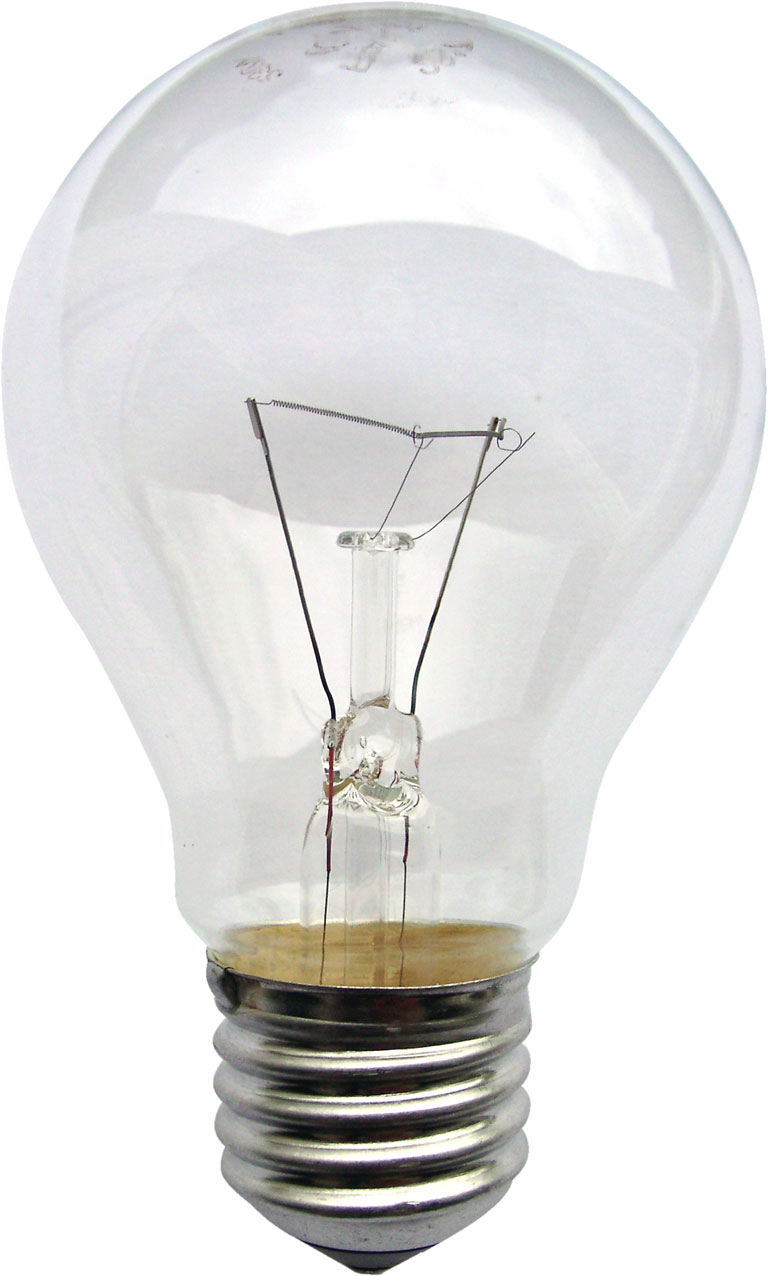
Resistance is not always a nuisance. The thin coiled wire inside an old-style bulb has high resistance; it gets so hot that it glows white. The heating element in a kettle or an iron works the same way. A resistor is a component made on purpose to have a fixed resistance, used to control current in radios, phones and chargers.
Four things increase the resistance of a wire:
- Greater length.
- Smaller thickness (cross-section).
- A material that conducts poorly.
- Higher temperature (for metals).
Try this
Two copper wires are the same length. One is twice as thick as the other. Which has the lower resistance?
8 / 42
Recap 1: the three quantities
| Quantity | Symbol | Unit | What it means | Measured with |
|---|---|---|---|---|
| Current | I | ampere (A) | flow of charge | ammeter, in series |
| Voltage | V | volt (V) | energy per coulomb, the push | voltmeter, in parallel |
| Resistance | R | ohm (Ω) | opposition to flow | ohmmeter / calculation |
The water picture: voltage is the height of the tank, current is the flow from the tap, resistance is how narrow the pipe is.
Quick quiz
- What unit is current measured in?
- Is an ammeter connected in series or in parallel?
- Which has more resistance: a long thin wire or a short thick one?
- Which way does conventional current flow?
Answers: amps; series; long thin; positive to negative.
9 / 42
Ohm's law
In 1827 Georg Ohm found a simple relationship. For a metal wire at steady temperature, the current is directly proportional to the voltage across it. Double the voltage, and you double the current.
The law is written:
V = I × R
Voltage = Current × Resistance.
Rearranged:
- I = V ÷ R (to find current)
- R = V ÷ I (to find resistance)
The triangle in the picture helps. Cover the quantity you want; what is left shows the formula.
Example. A 230 V heater has a resistance of 46 Ω. What current does it draw?
I = V ÷ R = 230 ÷ 46 = 5 A.
Example. A bulb carries 0.5 A when connected to a 12 V battery. Its resistance?
R = V ÷ I = 12 ÷ 0.5 = 24 Ω.

10 / 42
Try this: Ohm's law calculations
Use V = IR. Show your working and include units.
- A resistor of 10 Ω carries 2 A. What is the voltage across it?
- A 6 V battery is connected to a 3 Ω bulb. Find the current.
- A kettle draws 8 A from the 230 V mains. Find its resistance (1 d.p.).
- A phone charger supplies 5 V and 2 A. What is the resistance of the circuit it is feeding?
- A current of 0.25 A flows through a 240 Ω resistor. Find the voltage.
- The resistance of a torch bulb is 7.5 Ω and it carries 0.2 A. How many 1.5 V cells are needed?
Answers: 1) 20 V. 2) 2 A. 3) 28.75 ≈ 28.8 Ω. 4) 2.5 Ω. 5) 60 V. 6) V = 1.5 V, so one cell.
11 / 42
A simple circuit
A circuit is a complete, closed path that current can flow around. The simplest one has three parts:
- A source of voltage: a cell or battery.
- A load that uses the energy: a bulb, a motor, a buzzer.
- Conductors joining them: wires.
Usually there is also a switch, which opens a gap in the path to stop the current, or closes it to let current flow.
If the path is broken anywhere, by an open switch, a cut wire or a blown bulb, current stops everywhere in that loop. That is an open circuit. When the path is complete, it is a closed circuit.
In a working circuit the bulb glows, because its thin wire resists the current and turns electrical energy into heat and light.

12 / 42
Circuit symbols
Scientists and electricians draw circuits with standard symbols, so that anyone in the world can read them. Learn these for the exam.
- Cell: a long thin line beside a short thick line. The long line is the positive terminal.
- Battery: two or more cells in a row.
- Switch (open): a line with a gap, like a drawbridge lifted.
- Switch (closed): the gap bridged.
- Bulb (lamp): a circle with a cross inside.
- Resistor: a rectangle.
- Variable resistor: a rectangle with an arrow through it.
- Ammeter: a circle with an A.
- Voltmeter: a circle with a V.
- Fuse: a rectangle with a line through it.
- Wires: straight lines, with corners drawn square.
Rules for drawing: use a ruler, keep corners at right angles, do not let wires cross unless they are joined (draw a dot at a junction), and label every component.
Try this
Draw a circuit with a battery of two cells, a closed switch, one bulb and an ammeter, all in one loop. Add a voltmeter across the bulb.
13 / 42
Conductors and insulators
A conductor lets current flow easily, because it has many free electrons. An insulator does not, because its electrons are held tightly to their atoms.
Conductors: all metals, especially silver, copper, gold and aluminium. Also graphite (pencil lead), salty water, and the human body.
Insulators: rubber, plastic, glass, dry wood, dry air, ceramic, paper, dry cloth.
Look at any cable: copper in the middle (conductor) wrapped in plastic (insulator). The copper carries the current; the plastic keeps it in and keeps you out.
Semi-conductors such as silicon are in between. They are the basis of every chip in your phone, but that is a story for SHS.
Test it. Make a circuit with a cell, a bulb and two loose wire ends. Touch the ends to a coin, a plastic ruler, a pencil lead, a piece of chalk, a key. The bulb lights for conductors only.

14 / 42
Why water is dangerous
Pure water is actually a poor conductor. But the water in your house, in rivers and on your skin is never pure: it carries dissolved salts, and dissolved salts turn water into a conductor.
Your body is mostly salty water, so you conduct electricity. Dry skin has a fairly high resistance, which gives a little protection. Wet skin has a much lower resistance, so the same voltage pushes a far bigger current through you.
This is why:
- you must never touch switches or plugs with wet hands,
- bathrooms have pull-cord switches or switches outside the door,
- you must never use a phone that is charging while in the bath,
- flooded rooms must have the power switched off at the main before anyone enters.
A current of as little as 0.05 A (50 milliamps) through the chest can stop the heart. A mains socket can supply a hundred times that.
Try this
Explain, using the word resistance, why an electrician dries his hands before working.
15 / 42
Recap 2: Ohm's law and circuits
- V = I × R. Cover the one you want on the triangle.
- A circuit needs a source, a load and a complete conducting path.
- Open circuit: broken path, no current. Closed circuit: current flows.
- Learn the symbols: cell, battery, switch, bulb, resistor, ammeter, voltmeter, fuse.
- Conductors have free electrons (metals, graphite, salty water, people). Insulators do not (plastic, rubber, glass, dry wood).
Quick quiz
- 12 V across 4 Ω: current?
- What happens to the current in a loop when one bulb breaks?
- Name two conductors that are not metals.
- Why is wet skin more dangerous than dry skin?
16 / 42
Series circuits
In a series circuit, the components are joined one after another in a single loop. The current has only one path.
Three rules:
- The current is the same everywhere. An ammeter placed anywhere in the loop reads the same value.
- The voltages add up. The voltage across all the components together equals the battery voltage. V = V₁ + V₂ + V₃.
- The resistances add up. R_total = R₁ + R₂ + R₃.
Example. A 12 V battery is connected to a 2 Ω and a 4 Ω resistor in series.
R_total = 2 + 4 = 6 Ω. I = V ÷ R = 12 ÷ 6 = 2 A, everywhere. Voltage across 2 Ω: V = IR = 2 × 2 = 4 V. Voltage across 4 Ω: 2 × 4 = 8 V. Check: 4 + 8 = 12 V. Correct.
The big drawback: if one component fails, the whole loop is broken, and everything goes off. That is why cheap Christmas lights all die when one bulb blows.
17 / 42
Parallel circuits
In a parallel circuit, the components are connected side by side, each on its own branch. The current has more than one path.
Three rules:
- The voltage is the same across every branch, and equal to the battery voltage.
- The currents in the branches add up to the total current from the battery. I = I₁ + I₂ + I₃.
- The total resistance is less than the smallest branch resistance. For two resistors: 1/R = 1/R₁ + 1/R₂.
Example. A 12 V battery feeds a 4 Ω and a 6 Ω resistor in parallel.
Voltage across each: 12 V. Current in 4 Ω branch: 12 ÷ 4 = 3 A. Current in 6 Ω branch: 12 ÷ 6 = 2 A. Total current: 3 + 2 = 5 A. Total resistance: 12 ÷ 5 = 2.4 Ω. (Less than 4 Ω, as expected.)
If one branch breaks, the others keep working. That is why the lights in your house are wired in parallel: the kitchen bulb does not care whether the bedroom bulb has blown.

18 / 42
Series or parallel? Comparing them
| Series | Parallel | |
|---|---|---|
| Paths for current | one | two or more |
| Current | same everywhere | splits between branches |
| Voltage | shared between components | same across each branch |
| Total resistance | adds up (bigger) | smaller than any branch |
| One component fails | all stop | others keep working |
| Bulbs' brightness | dimmer as more are added | each stays bright |
| Used for | torches, simple switches, fuses | house wiring, car lights |
Bulb experiment. Connect two identical bulbs in series to a battery; both glow dimly. Connect the same two in parallel; both glow at full brightness, but the battery runs down faster, because it is supplying more current.
Try this
Why is a fuse always placed in series with the appliance it protects, never in parallel?
Answer: in series, all the current passes through the fuse, so it can cut the whole circuit when the current is too high.
19 / 42
Try this: series and parallel calculations
Series
- Three resistors of 3 Ω, 5 Ω and 7 Ω are in series with a 30 V battery. Find the total resistance and the current.
- Two bulbs are in series with a 6 V battery. The voltage across the first is 2.5 V. What is the voltage across the second?
Parallel
- A 9 V battery is connected across a 3 Ω and a 9 Ω resistor in parallel. Find the current in each branch and the total current.
- Two 10 Ω resistors are connected in parallel. What is their combined resistance?
- In a parallel circuit, the branch currents are 1.5 A, 2 A and 0.5 A. What current does the battery supply?
Answers: 1) 15 Ω, 2 A. 2) 3.5 V. 3) 3 A, 1 A, 4 A. 4) 5 Ω. 5) 4 A.
Sketch each circuit before calculating. In the exam, a labelled sketch earns marks even if the arithmetic goes wrong.
20 / 42
Measuring with meters
An ammeter measures current. It must be placed in series, so that the current flows through it. A good ammeter has almost zero resistance, so it does not change the current it is measuring.
A voltmeter measures voltage across a component. It is placed in parallel, one lead on each side of the component. A good voltmeter has very high resistance, so almost no current is diverted through it.
Connect them the wrong way round and you can damage them: an ammeter in parallel across a battery is almost a short circuit.
A multimeter combines both, plus an ohmmeter for resistance. Turn the dial to the quantity you want, choose a range higher than the value you expect, and connect the red lead to the positive side.
Try this
Draw a circuit with a cell, a switch and a resistor. Add an ammeter in the correct place to measure the current and a voltmeter in the correct place to measure the voltage across the resistor.

21 / 42
Recap 3: series and parallel
Series: one loop · same current · voltages add · resistances add · one fails, all fail.
Parallel: branches · same voltage · currents add · total resistance smaller · one fails, others work.
Meters: ammeter in series, voltmeter in parallel.
Quick quiz
- Two 6 Ω resistors in series: total?
- Two 6 Ω resistors in parallel: total?
- In which type of circuit do all components get the full battery voltage?
- Your house lights: series or parallel?
Answers: 12 Ω; 3 Ω; parallel; parallel.
22 / 42
Electrical power
Power is how fast energy is used. It is measured in watts (W). One watt is one joule of energy every second. A thousand watts is a kilowatt (kW).
For electrical appliances:
P = V × I
Power = Voltage × Current.
Example. A fan on the 230 V mains draws 0.3 A. Its power is 230 × 0.3 = 69 W.
Example. A 2,300 W water heater on 230 V draws I = P ÷ V = 2,300 ÷ 230 = 10 A. That is why heaters need thick cables and their own fuse.
Typical power ratings (look for the label on the back of the appliance):
- LED bulb: 9 W
- Old-style bulb: 60 W
- Television: 80 W
- Fridge: 150 W
- Iron: 1,000 W
- Air conditioner: 1,500 W
- Electric kettle: 2,000 W
Anything that makes heat uses a lot of power. That fact will matter when we get to the bill.
23 / 42
Energy and the kilowatt-hour
ECG does not charge you for power; it charges you for energy: power multiplied by time.
Energy = Power × Time
The scientific unit is the joule, but a joule is tiny. Electricity companies use a bigger unit, the kilowatt-hour (kWh), often just called a unit. One kWh is the energy used by a 1 kW appliance running for 1 hour.
Energy (kWh) = Power (kW) × Time (hours)
Example. A 2 kW kettle used for 15 minutes (0.25 h): 2 × 0.25 = 0.5 kWh.
Example. A 9 W LED bulb left on for 10 hours: 0.009 × 10 = 0.09 kWh.
Example. A 1.5 kW air conditioner running 8 hours a night: 1.5 × 8 = 12 kWh each night, or 360 kWh a month. That one appliance can use more than everything else in the house combined.
Try this
A 1,000 W iron is used for 2 hours a week. How many kWh does it use in four weeks?
Answer: 1 × 2 × 4 = 8 kWh.
24 / 42
Reading the ECG bill
Abena's family in Cape Coast uses a prepaid meter. They buy credit at a vendor or through mobile money, type the token into the meter, and the units appear. When the units run out, the power goes off. A postpaid customer gets a bill at the end of the month instead, based on a meter reading.
Either way, the charge is built from:
- Energy charge: the number of kWh used × the tariff (the price per kWh). Residential tariffs in Ghana are set by the PURC in blocks: the first block of units each month is cheapest, the next block costs more, and heavy users pay the highest rate.
- Service charge: a fixed monthly amount.
- Levies and VAT: government charges added to the total.
The exact tariff changes from year to year. The method does not.
Worked example (illustrative tariff). A home uses 150 kWh in a month. Suppose the first 50 units cost GH₵ 0.80 each and the rest GH₵ 1.50 each, with a service charge of GH₵ 10.
Energy: (50 × 0.80) + (100 × 1.50) = 40 + 150 = GH₵ 190. Plus service charge: GH₵ 200. Levies would be added on top.

25 / 42
Try this: the family bill
Kwame's family has these appliances and uses them as shown every day:
| Appliance | Power | Hours per day |
|---|---|---|
| 6 LED bulbs | 9 W each | 6 |
| Fridge | 150 W | 24 (runs about half the time, so count 12) |
| Television | 80 W | 5 |
| Standing fan | 60 W | 10 |
| Iron | 1,000 W | 0.5 |
- Work out the kWh used by each appliance in one day. (Convert watts to kilowatts first: 9 W = 0.009 kW.)
- Add them to find the total kWh per day.
- Multiply by 30 for the month.
- If every unit costs GH₵ 1.20 (illustrative), what is the energy charge for the month?
Answers: bulbs 0.324, fridge 1.8, TV 0.4, fan 0.6, iron 0.5; total 3.624 kWh/day; 108.72 kWh/month; about GH₵ 130.46.
Now add a 1.5 kW air conditioner for 8 hours a night and see what happens to the bill.
26 / 42
Cutting the bill
Because the bill depends on power × time, there are only two ways to lower it: use less powerful appliances, or use them for less time.
Swap for lower power
- Replace old 60 W bulbs with 9 W LEDs: same light, one-sixth of the energy.
- Choose appliances with a high energy-efficiency star rating (Ghana's Energy Commission label).
- Use a fan instead of an air conditioner when you can.
Reduce the time
- Switch off lights and fans in empty rooms.
- Unplug chargers and the TV at the wall; standby still draws current.
- Iron a week's clothes at once rather than heating the iron every morning.
- Do not open the fridge and stand there deciding; every opening makes the motor run.
- Set the air conditioner to 25 °C, not 18 °C.
Try this
A house has ten 60 W bulbs on for 6 hours daily. Calculate the monthly saving in kWh if all are swapped for 9 W LEDs.
Answer: (0.6 − 0.09) × 6 × 30 = 91.8 kWh.
27 / 42
Recap 4: power, energy and the bill
- P = V × I, in watts. Heating appliances use the most power.
- Energy = P (kW) × t (h), in kilowatt-hours (units).
- The ECG bill = units × tariff (in blocks) + service charge + levies.
- Prepaid: buy units first. Postpaid: pay after the meter is read.
- Save money by lowering power (LEDs, efficient appliances) and lowering time (switch off, unplug).
Quick quiz
- A 500 W appliance runs for 4 hours. Energy in kWh?
- 230 V, 5 A. Power?
- Which uses more energy in a day: a 9 W bulb for 24 hours or a 2,000 W kettle for 10 minutes?
Answers: 2 kWh; 1,150 W; the kettle (0.333 kWh vs 0.216 kWh).
28 / 42
The three-pin plug
Look inside a plug (with it unplugged). You will find three wires, each with a job and a colour.
- Live (brown): carries the current in from the supply at 230 V. Connected to the right-hand pin, through the fuse.
- Neutral (blue): carries the current back. Left-hand pin.
- Earth (green and yellow): a safety wire. Top, longest pin. It connects the metal casing of the appliance to the ground.
Older Ghanaian wiring sometimes uses the old colours: red for live, black for neutral, green for earth. If you ever see both systems in one house, ask an electrician to check it.
The cable grip at the bottom of the plug clamps the outer sheath so that pulling the cable does not pull the wires off their pins.
Try this
Draw a three-pin plug from the inside, label the three wires with their colours, and mark the fuse.

29 / 42
Fuses and circuit breakers
A fuse is a thin piece of wire inside a small cartridge, placed in series on the live wire. If the current grows too large, because of a fault or an overload, the wire heats up and melts, breaking the circuit before the cable catches fire.
Fuses are rated in amps: 3 A, 5 A, 13 A. Choose a fuse slightly above the normal current of the appliance. A 69 W fan draws 0.3 A, so a 3 A fuse is right. A 2,300 W heater draws 10 A, so it needs a 13 A fuse. Putting a 13 A fuse on the fan would let a dangerous current flow without blowing.
Never replace a fuse with a nail, a coin or a thick piece of wire. People do this in Ghana when the fuse keeps blowing. The fuse keeps blowing because something is wrong; bypassing it turns a warning into a fire.
A circuit breaker does the same job with a switch that trips instead of a wire that melts. It can be reset, which is why modern houses use breakers in the consumer unit (the "mains box").
Try this
A microwave is rated 1,150 W on 230 V. What current does it draw, and which fuse (3 A, 5 A or 13 A) should it have?
Answer: 5 A, so a 13 A fuse (5 A would be too close).
30 / 42
Earthing and shocks
Imagine a metal-bodied fridge. A wire inside comes loose and touches the metal casing. The casing is now at 230 V. Touch it, and current flows through you to the ground. That is an electric shock.
The earth wire prevents this. It connects the casing to the ground through a very low-resistance path. The moment the live wire touches the casing, a huge current rushes down the earth wire, the fuse blows, and the appliance is cut off before anyone touches it.
Appliances with plastic bodies (radios, phone chargers, hair dryers) are double insulated and have only two wires; there is no metal to earth.
Shock injuries range from a tingle to burns, to muscles locking so you cannot let go, to the heart stopping. If someone is being shocked: do not touch them. Switch off at the mains or knock the wire away with something dry and non-conducting, such as a wooden broom handle. Then call for help.
31 / 42
Dangers at home
Most electrical accidents in Ghana come from a short list of habits. Know them, and refuse to do them.
- Overloading sockets with multiple adaptors. Each socket is wired for about 13 A. Plug in a heater, an iron and a kettle together and the wires behind the wall can overheat.
- Damaged cables with the copper showing. Replace, do not tape.
- Illegal connections ("by-pass") that skip the meter and the breaker, leaving no protection at all.
- Wet hands on switches and plugs.
- Flying kites or climbing trees near power lines. Overhead lines are bare; a kite string wet with dew conducts.
- Building under high-voltage lines. GRIDCo lines carry 161,000 V; the air itself can conduct over short distances.
- Sleeping with a phone charging under the pillow. Chargers get hot; pillows trap heat.
- Children poking sockets. Use socket covers.

32 / 42
Electrical fires
An electrical fire starts when a wire or component gets hot enough to ignite something near it. Causes: overloaded sockets, loose connections that spark, bypassed fuses, faulty chargers.
If an electrical fire starts:
- Switch off the power at the mains, if you can reach it safely.
- Never pour water on it while the power is on. Water conducts; you could be electrocuted.
- Use a dry-powder or CO₂ extinguisher, or smother a small fire with a thick dry blanket or sand.
- Get everyone out and call the Ghana National Fire Service on 192.
Prevent it:
- One appliance per socket for anything that heats.
- Replace cracked plugs and frayed cables.
- Have wiring older than 20 years checked by a licensed electrician.
- Do not run cables under carpets, where heat cannot escape.
- Switch off and unplug heating appliances when you leave the house.
33 / 42
Recap 5: safety
- Plug: live brown, neutral blue, earth green/yellow. Fuse on the live.
- Fuse: melts when current is too high; rate it just above the normal current. Never bypass it.
- Earth: gives fault current a safe path so the fuse blows before you are shocked.
- Shock: do not touch the victim; cut the power first.
- Fire: switch off, no water, extinguisher or sand, call 192.
- Avoid: overloading, bare wires, wet hands, kites near lines, illegal connections.
Quick quiz
- Which wire is brown?
- A 60 W lamp on 230 V: 3 A or 13 A fuse?
- Why must you not pour water on an electrical fire?
Answers: live; 3 A; water conducts and could electrocute you.
34 / 42
Practical: build a circuit
You need: two 1.5 V cells, a cell holder or tape, three pieces of insulated wire with bare ends, two small torch bulbs with holders, a paper clip and two drawing pins for a switch.
Series
- Join the cells so the positive of one touches the negative of the other.
- Connect a wire from the battery's positive to bulb 1, bulb 1 to bulb 2, bulb 2 to the switch, and the switch back to the battery's negative.
- Close the switch. Both bulbs glow dimly. Unscrew one bulb: the other goes out.
Parallel
- Now connect bulb 1 directly across the battery, and bulb 2 also directly across the battery, with the switch on the battery's negative lead.
- Close the switch. Both bulbs glow brightly. Unscrew one: the other stays lit.
Record what you see in a table: arrangement, brightness, effect of removing one bulb. This is a standard BECE practical.
35 / 42
Practical: conductor or insulator?
Build the simplest circuit: one cell, one bulb, and leave a gap between two loose wire ends.
Test these objects by bridging the gap with them:
| Object | Prediction | Bulb lit? | Conductor or insulator? |
|---|---|---|---|
| Coin | |||
| Plastic pen | |||
| Pencil lead (graphite) | |||
| Rubber band | |||
| Key | |||
| Piece of chalk | |||
| Aluminium foil | |||
| Dry wood | |||
| Wet string |
Write your prediction before testing. Then test and complete the table. Were any results surprising? Pencil lead and wet string often are.
Finish with a sentence explaining, in terms of free electrons, why metals conduct and plastics do not.
36 / 42
Worked BECE-style question
(a) State Ohm's law. (b) A resistor of 20 Ω is connected to a 10 V battery. Calculate the current. (c) A second resistor of 30 Ω is added in series. Calculate (i) the total resistance, (ii) the new current, (iii) the voltage across the 30 Ω resistor. (d) State one advantage of connecting lamps in parallel in a house.
(a) The current through a metallic conductor is directly proportional to the voltage across it, provided the temperature stays constant.
(b) I = V ÷ R = 10 ÷ 20 = 0.5 A.
(c)(i) R = 20 + 30 = 50 Ω. (ii) I = 10 ÷ 50 = 0.2 A. (iii) V = IR = 0.2 × 30 = 6 V.
(d) If one lamp fails, the others continue to work (or: each lamp receives the full supply voltage).
Marks come for the statement, the formula, the substitution and the answer with unit. Write all four, every time.
37 / 42
Mixed practice
- Define current, and name its unit and the instrument that measures it.
- 4.5 C of charge flows in 3 s. Find the current.
- A heater of resistance 23 Ω runs on 230 V. Find the current and the power.
- Three 4 Ω resistors: find the total resistance in series, and in parallel.
- Explain why the earth pin on a plug is longer than the other two. (Hint: it makes contact first and breaks contact last.)
- A TV (80 W) runs 6 hours a day for 30 days. Find the energy in kWh and the cost at GH₵ 1.20 per unit.
- Give two reasons why a fuse must never be replaced with a piece of ordinary wire.
- A student connects an ammeter in parallel with a bulb. What will happen?
- List three ways to reduce a household electricity bill.
- Why are transmission lines run at very high voltage? (Hint: P = VI; for the same power, higher V means lower I, and lower I means less heat lost in the wires.)
38 / 42
Revision card
Quantities: I (A) = Q ÷ t · V (V) = energy per coulomb · R (Ω) = opposition.
Ohm's law: V = I R.
Power: P = V I (W). Energy: E = P × t (kWh = kW × h).
Series: same I · V adds · R adds · one fails, all fail.
Parallel: same V · I adds · 1/R = 1/R₁ + 1/R₂ · one fails, rest work.
Meters: ammeter in series, voltmeter in parallel.
Plug: live brown (fused), neutral blue, earth green/yellow.
Bill: units × tariff (blocks) + service charge + levies. Lower P or lower t.
Safety: no wet hands · no overloading · no bypassed fuses · no kites near lines · cut power before helping a shock victim · no water on electrical fires · call 192.
39 / 42
Learn more
- Khan Academy: Circuits — videos and practice on current, voltage, resistance and circuit analysis.
- PhET Circuit Construction Kit — build series and parallel circuits on screen and watch the meters.
- Electricity Company of Ghana — tariffs, prepaid vending, safety notices and how to report faults.
- Public Utilities Regulatory Commission — the body that sets Ghana's electricity tariffs each year.
- GRIDCo — Ghana's transmission company; see how power moves from Akosombo to your town.
40 / 42
Watch more
41 / 42
Think about it
- Street lights in a town are wired so that if one fails the others stay on. Which arrangement is that, and what would happen with the other arrangement?
- Why do you think Ghana's supply is 230 V rather than, say, 12 V, which would be far safer to touch?
- A neighbour says, "The fuse keeps blowing, so I put in a thicker wire and now it is fine." What has he actually done, and what might happen next?
- If your family could change only one habit to cut the ECG bill, which would save the most, and how would you prove it with a calculation?
- Solar panels are becoming cheaper. What would change in your community if every school had its own solar supply?
42 / 42
This book is for reading on SchoolSpec and cannot be printed.