Social Studies
Colonisation and Independence
Colonisation and independence in West Africa
From the Gold Coast forts and the trade in gold and people, through colonial rule and resistance, to 6 March 1957 and the ECOWAS of today.
Why this history is yours
On 6 March every year, Ghana's flag goes up at Black Star Square and schoolchildren march past in the heat. Most of them can say that it is Independence Day. Fewer can say independence from what, how it was lost in the first place, and who fought to win it back.
This book tells that story, from the first European ships off the coast of what is now Ghana, through four centuries of trade and conquest, to the midnight when Kwame Nkrumah declared "Ghana, your beloved country, is free forever", and on to the West Africa of today, where fifteen countries work together in ECOWAS.
It is not only Ghana's story. Nigeria, Senegal, Côte d'Ivoire, Sierra Leone and every West African state lived a version of it. Understanding it helps you understand borders, languages, money, the names of streets and even the subjects on your timetable.
As you read, keep asking three questions: Who had power? How did they get it? Who resisted?
2 / 38
West Africa before the Europeans
In 1400, long before any European ship arrived, West Africa was home to powerful states.
Mali had grown rich on gold and salt; its ruler Mansa Musa made a pilgrimage to Mecca in 1324 so lavish that the price of gold in Cairo fell. Songhai followed, with the university city of Timbuktu. On the forest edge, the Akan states, including what became Asante, mined gold and traded it north across the Sahara. On the coast, Fante, Ga and Ewe communities fished, farmed and traded salt.
These societies had kings, courts, armies, taxes, markets, writing in Arabic in the north, and oral historians who kept the past alive. They were not waiting to be "discovered".
What they did not have, and what would matter enormously, was contact with the Atlantic world. That changed in 1471, when Portuguese sailors reached the coast and found so much gold for sale that they called it A Mina, the mine: Elmina.
3 / 38
The forts and castles
In 1482 the Portuguese built São Jorge da Mina, Elmina Castle, the oldest European building south of the Sahara. It was a trading post with thick walls: gold, ivory and pepper came in from the interior; cloth, metal goods, guns and alcohol came off the ships.
Over the next two centuries the Dutch, English, Danes, Swedes and Brandenburgers all built forts along the coast: Cape Coast Castle, Fort Amsterdam at Abandze, Christiansborg at Osu, Fort Metal Cross at Dixcove. More than thirty survive. Together they are a UNESCO World Heritage Site.
The Europeans did not conquer the land at first. They rented the ground from local rulers, paid rent and gifts, and competed with each other. The Dutch took Elmina from the Portuguese in 1637; the English built up Cape Coast after 1664.
The forts were built for gold. Within a hundred years they were being used for something far worse.

4 / 38
The trade in people
From the 1500s, European colonies in the Americas needed labour for sugar, tobacco and cotton plantations. The answer the Europeans chose was the transatlantic slave trade.
Captives were brought to the coast, often prisoners of war sold by African states that had been pulled into the trade, and sometimes people kidnapped outright. In the castles they were held in dungeons, sometimes for months, then marched through the "Door of No Return" onto ships. The crossing, the Middle Passage, killed roughly one in six.
Across more than three centuries, about twelve million Africans were forced across the Atlantic. The Gold Coast alone lost hundreds of thousands. The trade armed some states with guns, which they used to capture more people, and weakened others; it bred fear, war and distrust that lasted generations.
Britain abolished its slave trade in 1807 and slavery in its colonies in 1833. The Danes had stopped in 1803. The trade did not end because the castles closed; it ended because Africans resisted, enslaved people rebelled, and campaigners in Europe and the Americas fought for decades.

5 / 38
"Legitimate trade" and growing influence
After abolition, Europeans spoke of legitimate trade: palm oil for soap and machine grease, rubber, timber, and later cocoa. Trade continued; the balance of power shifted.
British merchants and officials on the coast began to act as judges in disputes between Fante towns. In 1844, a group of Fante chiefs signed the Bond of 1844 with Governor George Maclean, agreeing that serious crimes would be tried under British supervision. The chiefs saw it as a partnership against Asante pressure from the north. The British came to see it as the beginning of their right to rule.
In 1874, after defeating Asante at the Battle of Amoaful and burning Kumasi, Britain declared the coastal region the Gold Coast Colony. The old arrangement of renting forts was over. From now on, Britain claimed to govern.
Try this
In one sentence each, explain how the Fante chiefs and the British might have understood the Bond of 1844 differently.
6 / 38
Recap 1: before colonial rule
- West Africa had rich, organised states (Mali, Songhai, Asante, Fante, Ga, Ewe) before 1471.
- The Portuguese built Elmina Castle in 1482 for the gold trade; other Europeans followed.
- From the 1500s the castles became prisons for the transatlantic slave trade; about twelve million Africans were taken.
- Abolition came in the early 1800s; "legitimate trade" in palm oil and cocoa replaced it.
- The Bond of 1844 and the war of 1874 turned British influence into the Gold Coast Colony.
Quick quiz
- Why did the Portuguese call the place "A Mina"?
- Name three European nations that built forts on the coast.
- What was the Middle Passage?
- In what year did the Gold Coast become a British colony?
7 / 38
The Scramble for Africa
In 1870, Europeans controlled about one-tenth of Africa, mostly on the coasts. By 1914 they controlled nearly all of it. Historians call this the Scramble for Africa.
Why so fast? Europe's factories wanted raw materials (palm oil, rubber, cotton, minerals) and markets for their goods. Rival nations, especially Britain, France and Germany, feared being left out. New tools made conquest easier: quinine against malaria, steamships up the rivers, the Maxim machine gun.
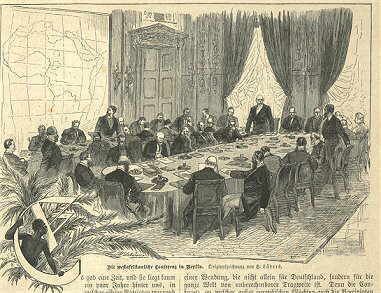
At the Berlin Conference of 1884–85, fourteen European nations and the United States sat round a table and agreed rules for dividing Africa. No African was present. Lines were drawn on maps through forests and across rivers that none of the diplomats had seen, cutting through the lands of the Ewe, the Hausa, the Yoruba and dozens of others.
Those lines, with small changes, are the borders of West Africa today.
8 / 38
The map of 1913
By 1913, the map of West Africa looked like this:
- Britain: Gold Coast, Nigeria, Sierra Leone, the Gambia.
- France: a vast block from Senegal to Niger called French West Africa, plus Dahomey (Benin), Côte d'Ivoire and Guinea.
- Germany: Togoland and Kamerun (taken by Britain and France after 1914).
- Portugal: Guinea-Bissau.
- Liberia stayed independent, founded in 1847 by freed African Americans.
Notice how the Ewe people were split between the Gold Coast and German (later British and French) Togoland. The Hausa were divided between British Nigeria and French Niger. A trader in Aflao today still crosses a line drawn in a European office.
The Gold Coast itself was assembled in stages: the Colony (the coast) in 1874, Asante after the war of 1896 and the rising of 1900, and the Northern Territories as a protectorate in 1902. British Togoland was added after the First World War.

9 / 38
Asante resists
The Asante Empire, founded by Osei Tutu around 1700 with the Golden Stool as the symbol of the nation's soul, was the most powerful state in the region. It fought Britain five times across the 1800s.
In 1824 Asante defeated and killed Governor Sir Charles MacCarthy. In 1874 the British reached and burnt Kumasi. In 1896 they exiled the Asantehene, Prempeh I, to the Seychelles.
Then in 1900 the British governor, Frederick Hodgson, came to Kumasi and demanded to sit on the Golden Stool. To Asante ears this was not a demand for a chair; it was a demand for the soul of the nation. The chiefs hesitated. Then Yaa Asantewaa, Queen Mother of Ejisu, challenged them:
"If you, the men of Asante, will not go forward, then we will. We, the women, will."
She led the War of the Golden Stool. The British garrison was besieged in Kumasi fort for months before relief arrived. Asante lost and was annexed in 1902, but the Golden Stool was never captured. Yaa Asantewaa died in exile in 1921; her name is on schools and streets across Ghana.

10 / 38
Other resistance across West Africa
Asante was not alone. Everywhere the Europeans advanced, Africans fought back.
- Samori Touré built a large state in what is now Guinea, Mali and Côte d'Ivoire, and fought the French for sixteen years (1882–1898) with his own gun factories, before he was captured.
- Bai Bureh led the Hut Tax War in Sierra Leone in 1898 against a British tax on every house.
- The Ekumeku movement in Nigeria harassed the British in the Niger delta for twenty years.
- In the Gold Coast, the Aborigines' Rights Protection Society, founded in 1897 by educated Fante leaders, stopped the Lands Bill, which would have handed unused land to the Crown. They sent a delegation to London and won. This was resistance by petition and argument, not arms.
Military resistance was usually defeated by better weapons. But it slowed conquest, kept the memory of independence alive and taught the next generation that the colonial order could be challenged.
Try this
Compare armed resistance (Yaa Asantewaa, Samori) with legal resistance (the ARPS). What did each achieve, and what did each cost?
11 / 38
Recap 2: conquest and resistance
- The Scramble for Africa (1870–1914) was driven by raw materials, markets, rivalry and new technology.
- The Berlin Conference (1884–85) set the rules; no Africans attended; today's borders come from it.
- The Gold Coast was built from the Colony (1874), Asante (1902), the Northern Territories (1902) and British Togoland (after 1919).
- Asante fought five wars; Yaa Asantewaa led the War of the Golden Stool in 1900.
- Samori Touré, Bai Bureh and the ARPS resisted in different ways across the region.
Quick quiz
- Which weapon gave Europeans a decisive advantage?
- What did Governor Hodgson demand in 1900?
- What was the Aborigines' Rights Protection Society fighting against?
12 / 38
How colonial rule worked
Britain governed the Gold Coast through a Governor in Accra, appointed from London, with a Legislative Council that at first had no elected Africans at all.
Outside the capital, Britain used indirect rule: chiefs were kept in place and made to collect taxes, recruit labour and enforce laws on Britain's behalf. A chief who co-operated was recognised; a chief who did not was destooled by the governor. This cut the cost of ruling, but it also changed chieftaincy. Chiefs who had once answered to their people now answered upwards, to the District Commissioner.
France, by contrast, used direct rule and assimilation: French officials governed, French was the only language of administration, and a small number of Africans who adopted French culture could become citizens.
In both systems, the top jobs were European, the laws were made abroad, and the purpose of the colony was to serve the ruling country's economy.
Try this
List two advantages and two disadvantages of indirect rule, from the point of view of (a) the British and (b) the people of a Gold Coast village.
13 / 38
The colonial economy
The Gold Coast was shaped to export raw materials and import manufactured goods.
Cocoa was the great story. Tetteh Quarshie is credited with bringing cocoa seeds from Fernando Po in 1879. By 1911 the Gold Coast was the world's largest cocoa producer, and almost all of it was grown by African farmers on their own land. But the price was set by European buying firms, and in 1937 farmers organised a cocoa hold-up, refusing to sell until the firms paid fairly.
Gold was mined at Obuasi and Tarkwa by European companies. Timber and manganese followed. Railways were built, not to link Ghanaian towns to each other, but to carry minerals and cocoa from the interior to the ports at Sekondi, Takoradi and Accra.
Taxes and customs duties paid for the administration. Schools, mostly run by missions, trained clerks, teachers and catechists. A small educated class grew in Cape Coast, Accra and Kumasi, reading newspapers and asking why they could not govern themselves.

14 / 38
The Golden Stool returns to the story
In 1921, road workers near Kumasi dug up the Golden Stool, which had been hidden since 1900. Some of its gold ornaments had been stripped and sold. Asante was outraged.
The British, who had wanted the Stool for twenty years, now did something different. They allowed Asante to punish the culprits under Asante custom and left the Stool alone. In 1924 they let Prempeh I return from exile, and in 1935 they restored the Asante Confederacy with his successor, Prempeh II, as Asantehene.
Why the change? Partly cost: it was cheaper to rule through a respected king. Partly fear: the 1900 war had been expensive. And partly the educated Gold Coasters were now pressing for reforms in the Legislative Council, and Britain hoped that strong traditional rulers would balance them.
The lesson for students of history: colonial policy was never fixed. It shifted with money, fear and pressure from below.

15 / 38
The Second World War changes everything
Between 1939 and 1945 about 65,000 Gold Coast men served in the British army, many in the Gold Coast Regiment that fought the Japanese in Burma. They saw Europeans frightened and defeated, fought alongside Indians who were demanding independence, and heard the Allies promise, in the Atlantic Charter, that all peoples had the right to choose their own government.
They came home to unemployment, high prices and no reward. Britain, meanwhile, was bankrupt and could no longer afford a huge empire. India became independent in 1947. The question was no longer whether the Gold Coast would be free, but when and how.
In August 1947 a group of lawyers and businessmen founded the United Gold Coast Convention (UGCC) under J. B. Danquah with the slogan "self-government in the shortest possible time". They invited a young man studying in London to come home and be their General Secretary. His name was Kwame Nkrumah.
16 / 38
Recap 3: colonial rule
- Britain ruled through a Governor and indirect rule via chiefs; France used direct rule and assimilation.
- The economy exported cocoa, gold, timber and manganese; railways ran from the interior to the ports.
- Cocoa farmers organised the 1937 hold-up against unfair prices.
- The Golden Stool resurfaced in 1921; the Asante Confederacy was restored in 1935.
- The Second World War created ex-servicemen, economic hardship and new ideas; the UGCC was founded in 1947.
Quick quiz
- Who is credited with bringing cocoa to the Gold Coast?
- What is indirect rule?
- What did the Atlantic Charter promise?
- Who founded the UGCC, and whom did they invite home?
17 / 38
28 February 1948
On 28 February 1948, three ex-servicemen, Sergeant Adjetey, Corporal Attipoe and Private Odartey Lamptey, led a peaceful march to Christiansborg Castle to present a petition to the Governor about their unpaid benefits. At the crossroads near the castle, a British police officer ordered the marchers to stop, then opened fire. All three were killed.
Accra erupted. Crowds looted European shops, already hated because of a boycott against high prices organised by Nii Kwabena Bonne II. Riots spread to Kumasi and other towns. Twenty-nine people died.
The Governor blamed the UGCC and arrested its six leaders: Danquah, Nkrumah, Akufo-Addo, Ako Adjei, Obetsebi-Lamptey and William Ofori Atta. They became known as the Big Six. Their detention made them heroes.
Britain set up the Watson Commission, which reported that the colony's constitution was "outmoded" and that the people wanted self-government. For the first time, London admitted that the Gold Coast would have to be given real political power.

18 / 38
Nkrumah and the CPP
The UGCC leaders wanted independence gradually, led by educated men like themselves. Nkrumah wanted it now, and he wanted ordinary people, market women, farmers, clerks and school leavers, to lead the demand.
In June 1949, he broke away and founded the Convention People's Party (CPP) with the slogan "Self-Government Now". The CPP organised like no party before it: branches in every town, a newspaper (the Accra Evening News), rallies, songs, the red cockerel symbol.
In January 1950 Nkrumah called Positive Action: a general strike and boycott, modelled on Gandhi's non-violent campaigns in India. The Governor declared a state of emergency and jailed him for sedition.
Then came the first general election under a new constitution, in February 1951. The CPP won 34 of the 38 elected seats. Nkrumah won his Accra seat from inside James Fort prison. The Governor, Sir Charles Arden-Clarke, released him and invited him to become Leader of Government Business, in effect the colony's first prime minister.
19 / 38
The road to 1957
From 1951, the Gold Coast was governed by its own elected ministers under a British Governor. Nkrumah's government used the cocoa boom to build schools, roads and the Tema harbour, and planned the Volta River dam.
Not everyone agreed with him. The National Liberation Movement, strong in Asante, wanted a federal Ghana with power for the regions. Northern leaders feared domination by the south. The Togoland question, whether British Togoland would join the new state, was settled by a UN plebiscite in 1956.
The CPP won elections again in 1954 and 1956. Britain finally agreed on a date. In the last session of the Legislative Assembly, Nkrumah proposed the name Ghana, after the medieval empire, to show that the new state looked back to African greatness, not to a colonial label about gold.
At midnight on 6 March 1957, at the Old Polo Grounds in Accra, the Union Jack came down and the red, gold and green flag with its black star went up. Ghana became the first country in sub-Saharan Africa to win independence from colonial rule.

20 / 38
"Free forever"
Nkrumah's speech that night was short. He said:
"At long last, the battle has ended! And thus Ghana, your beloved country, is free forever."
And then the sentence that still echoes across the continent:
"Our independence is meaningless unless it is linked up with the total liberation of the African continent."
He meant it. Ghana became a base for freedom fighters from across Africa. Nkrumah hosted the All-African Peoples' Conference in 1958 and helped found the Organisation of African Unity in 1963.
The video below is rare footage from 1957. Watch for the faces in the crowd: the market women and ex-servicemen who built the CPP, now watching the flag rise.
21 / 38
Recap 4: the independence movement
- 28 February 1948: three ex-servicemen shot; riots; the Big Six detained; the Watson Commission.
- 1949: Nkrumah founds the CPP, "Self-Government Now".
- 1950: Positive Action; Nkrumah jailed. 1951: CPP wins the election; Nkrumah released to lead government.
- 1951–56: self-rule under a Governor; opposition from the NLM and the north; Togoland plebiscite.
- 6 March 1957: independence; the name Ghana; "free forever".
Quick quiz
- Name the three ex-servicemen shot in 1948.
- What was the CPP's slogan?
- Where was Nkrumah when he won his seat in 1951?
- Why was the name "Ghana" chosen?
22 / 38
Independence spreads across West Africa
Ghana opened the door, and the rest of West Africa walked through it within a decade.
- 1958: Guinea, under Sékou Touré, voted "No" to staying in a French Community and became independent at once. France withdrew everything, down to the telephones.
- 1960: the "Year of Africa". Nigeria, Senegal, Mali, Côte d'Ivoire, Togo, Benin (Dahomey), Niger, Burkina Faso (Upper Volta), Mauritania and Cameroon all became independent.
- 1961: Sierra Leone. 1965: the Gambia.
- 1973–74: Guinea-Bissau, after a long armed struggle against Portugal, which refused to leave peacefully.
Most transitions were negotiated, like Ghana's. A few, such as Guinea-Bissau's, were wars. Everywhere, the new states inherited the borders of Berlin, economies built for export, and governments designed for control rather than democracy.
23 / 38
Legacies of colonialism
What did colonial rule leave behind? Historians argue, and so should you.
On one side: railways, harbours, hospitals, schools, a common official language, the law courts and the civil service. Cocoa, which still earns Ghana billions. Borders that, whatever their origin, now hold nations together.
On the other side: economies built to export raw materials and import finished goods, a pattern that continues. Borders that split peoples and pack rivals together. Education designed to produce clerks, not engineers. Chiefs turned into tax collectors. Racial laws, forced labour, and the lasting memory of the castles.
And the deepest legacy, in the words of the Kenyan writer Ngũgĩ wa Thiong'o, was in the mind: generations taught that their own languages, histories and gods were inferior.
Try this
Draw a table with two columns, "Gains" and "Losses". Fill it in from this page and your own knowledge. Then write one paragraph: on balance, what do you conclude?
24 / 38
Ghana after 1957
Independence did not end the story. Nkrumah built the Akosombo Dam, Tema, free primary education and new universities. He also banned opposition parties, made Ghana a one-party state in 1964, and was overthrown in a coup in 1966 while abroad.
Then came decades of instability: coups in 1972, 1979 and 1981, short civilian governments, economic crisis in the early 1980s. Jerry Rawlings ruled from 1981 and, after a new constitution in 1992, Ghana returned to multi-party democracy. Since then, power has changed hands peacefully through elections several times, which few African countries can say.
Nkrumah's body now rests in the Kwame Nkrumah Mausoleum at the Old Polo Grounds, where the flag first went up. Across the road is the Black Star Square where you march on 6 March.
Independence, it turns out, is not a single night. It is a job that each generation has to do again.

25 / 38
Recap 5: after independence
- Guinea 1958; the Year of Africa 1960; Sierra Leone 1961; the Gambia 1965; Guinea-Bissau 1974.
- Colonial legacies cut both ways: infrastructure and cocoa versus export-dependence, divided peoples and colonised minds.
- Ghana: Nkrumah's achievements and his one-party state; the coup of 1966; the 1992 constitution and stable democracy since.
Quick quiz
- Which West African country voted "No" to France in 1958?
- Why is 1960 called the Year of Africa?
- In what year was Nkrumah overthrown?
- What happened in 1992?
26 / 38
ECOWAS: West Africa together
In 1975, fifteen West African states signed the Treaty of Lagos and created the Economic Community of West African States (ECOWAS), known in French as the CEDEAO. Its headquarters are in Abuja, Nigeria.
The founders' idea was simple: the colonial borders had carved a connected region into small, weak markets. By working together, West Africa could trade more, build more and speak with one voice.
ECOWAS aims include:
- Free movement of people and goods across member borders.
- A common market and, one day, a single currency (the planned "Eco").
- Joint infrastructure: the Abidjan–Lagos highway, the West African Power Pool that lets Ghana sell electricity to Burkina Faso.
- Peace and security: the ECOMOG force intervened in the civil wars in Liberia (1990) and Sierra Leone (1997).
Ghana was a founding member and remains one of its leading voices.

27 / 38
ECOWAS in your life
ECOWAS is not just for diplomats. It touches ordinary Ghanaians:
- A Ghanaian with a valid passport or ECOWAS travel certificate can enter any member state without a visa and stay for 90 days. Traders from Aflao to Lagos use this every day.
- ECOWAS Brown Card motor insurance covers a car across member states.
- Ghanaian students study in Nigeria and Senegal; Nigerian businesses operate in Accra.
- The ECOWAS Court of Justice can hear cases brought by citizens against their own governments.
- When Ghana's power supply is short, electricity can come across the border from Côte d'Ivoire through the regional grid.
It has problems too. Borders are still slow, with many checkpoints. Military coups in Mali, Burkina Faso and Niger led those three countries to announce in 2024 that they were leaving. The single currency has been delayed many times.
Try this
Interview someone who has travelled to another ECOWAS country. What was easy, and what was hard, at the border?
28 / 38
Timeline: four centuries in one page
- 1471 Portuguese reach the coast.
- 1482 Elmina Castle built.
- 1637 Dutch take Elmina. 1664 English at Cape Coast.
- 1700s Asante Empire rises; slave trade at its height.
- 1807 Britain abolishes its slave trade.
- 1844 The Bond of 1844.
- 1874 Gold Coast Colony declared.
- 1884–85 Berlin Conference.
- 1896 Prempeh I exiled. 1900 Yaa Asantewaa's war. 1902 Asante and the North annexed.
- 1935 Asante Confederacy restored.
- 1947 UGCC founded. 1948 28 February shootings; the Big Six.
- 1949 CPP founded. 1951 CPP wins election.
- 1957 6 March: independence.
- 1960 Ghana a republic; the Year of Africa.
- 1966 Nkrumah overthrown.
- 1975 ECOWAS founded.
- 1992 Fourth Republic constitution.
Copy this timeline into your book. Then add three events of your own choosing.
29 / 38
Key people
Osei Tutu — founder of the Asante Empire, c. 1700, with the Golden Stool.
Tetteh Quarshie — brought cocoa seeds in 1879.
Yaa Asantewaa — Queen Mother of Ejisu, led the 1900 war.
Prempeh I — Asantehene exiled in 1896, returned 1924.
Samori Touré — resisted the French for sixteen years.
J. B. Danquah — founder of the UGCC; proposed the name Ghana.
Kwame Nkrumah — founder of the CPP, first Prime Minister and President.
The Big Six — Danquah, Nkrumah, Akufo-Addo, Ako Adjei, Obetsebi-Lamptey, Ofori Atta.
Sergeant Adjetey, Corporal Attipoe, Private Odartey Lamptey — shot on 28 February 1948.
Sir Charles Arden-Clarke — the last British Governor, who released Nkrumah in 1951.
Try this
Pick one person and write a 100-word profile: who they were, what they did, why it mattered.
30 / 38
Key terms
- Colony — a territory ruled by a foreign power.
- Protectorate — a territory "protected" by a foreign power, which in practice controlled it.
- Indirect rule — governing through local chiefs.
- Assimilation — the French policy of turning colonised people into French citizens.
- Scramble for Africa — the rapid European conquest of Africa, 1870–1914.
- Nationalism — the belief that a people should govern themselves.
- Positive Action — Nkrumah's campaign of strikes and boycotts, 1950.
- Self-government — ruling yourself; the step before full independence.
- Independence — full freedom from foreign rule.
- Decolonisation — the process by which colonies became independent.
- Pan-Africanism — the idea that all African peoples should unite.
- Regional integration — countries joining together economically and politically, as in ECOWAS.
Learn these for the exam. Use them in your answers; they show the examiner you understand the subject's language.
31 / 38
Worked BECE-style question
(a) State two reasons why Europeans built forts and castles on the coast of the Gold Coast. (b) Explain three ways in which the 1948 riots contributed to the independence of Ghana. (c) Mention two aims of ECOWAS.
(a) To store goods and protect their trade in gold (and later enslaved people) from rivals; to serve as a base from which to trade with the interior.
(b) (i) The shooting of the ex-servicemen and the riots showed Britain that the people were deeply unhappy and could not be ignored. (ii) The arrest of the Big Six made them national heroes and united people behind the demand for self-government. (iii) The Watson Commission that followed recommended constitutional reform, leading to the 1951 election and African ministers.
(c) To promote free movement of people and goods; to maintain peace and security in the region (or: to create a common market and single currency).
Note the pattern: a point, then an explanation of why it mattered. One-word answers rarely earn full marks in history.
32 / 38
Practice questions
Answer in full sentences.
- Describe the role of Elmina Castle in (a) the gold trade and (b) the slave trade.
- Explain why the Bond of 1844 is seen as a turning point.
- Why did the Berlin Conference matter for West Africa, even though it was held in Europe?
- Describe the events of 1900 in Asante and explain why the Golden Stool was so important.
- Compare the aims and methods of the UGCC and the CPP.
- Explain how the Second World War helped the independence movement.
- "The 1951 election was the real independence of Ghana." Do you agree? Give reasons.
- Give three benefits and two problems of ECOWAS for Ghana today.
Swap your answers with a classmate and mark them against the recap pages. For each answer, ask: does it name a fact, and does it explain why the fact matters?
33 / 38
Visit the history
You can stand where this history happened.
- Elmina and Cape Coast Castles — walk through the dungeons and the Door of No Return. Guides explain the trade in detail. Entry is cheap for Ghanaian students.
- Fort Christiansborg (Osu Castle) — the seat of government from 1902 until 2013, now partly open to visitors.
- Kwame Nkrumah Memorial Park, Accra — his tomb, his statue, and a museum of his life.
- The Manhyia Palace Museum, Kumasi — the story of the Asantehenes, including Prempeh I and the 1900 war.
- Yaa Asantewaa Museum, Ejisu — rebuilt after a fire, near her home.
- The National Museum, Accra.
- Ussher Fort and James Fort, Accra — where Nkrumah was jailed in 1950.
If a trip is impossible, many of these places have virtual tours and photographs online. Ask your teacher to help arrange a class visit; a single afternoon in Cape Coast Castle teaches more than a week of notes.

34 / 38
Revision card
Before 1471: Mali, Songhai, Asante, Fante, Ga, Ewe — organised states.
1482–1800s: forts and castles; gold, then the slave trade (12 million); abolition 1807.
1844–1902: Bond of 1844 → Colony 1874 → Berlin 1884–85 → Asante wars, Yaa Asantewaa 1900 → Asante and North annexed 1902.
Colonial rule: Governor + indirect rule via chiefs; cocoa, gold, railways to ports; ARPS; Confederacy restored 1935.
Road to freedom: WWII → UGCC 1947 → 28 Feb 1948, Big Six → CPP 1949 → Positive Action 1950 → election 1951 → 6 March 1957.
After: Year of Africa 1960; coup 1966; Fourth Republic 1992.
ECOWAS: founded 1975, Lagos; HQ Abuja; free movement, common market, ECOMOG, power pool.
Ask always: who had power, how did they get it, who resisted?
35 / 38
Learn more
- ECOWAS — the official site: member states, treaties, free-movement rules and news.
- UNESCO: Forts and Castles of Ghana — why the coastal forts are a World Heritage Site, with photographs.
- Ghana Museums and Monuments Board — the castles, forts and museums you can visit.
- The National Archives (UK): Education — original colonial-era documents and lesson resources.
- NaCCA — Ghana's curriculum council, home of the Basic 9 Social Studies syllabus.
36 / 38
Watch more
37 / 38
Think about it
- African rulers took part in the slave trade as sellers. Does that change how we should judge the Europeans who ran it? How?
- If the Berlin Conference had never happened, what might the map of West Africa look like today?
- Was Yaa Asantewaa right to fight a war she was likely to lose? What did Asante gain from it?
- Nkrumah said independence was meaningless without the liberation of all Africa. Has that idea been fulfilled, or abandoned?
- Three countries left ECOWAS in 2024. What would Ghana lose if ECOWAS collapsed, and what would it lose if it stayed in a weaker ECOWAS?
- What, in your own school and town, is still shaped by colonial rule? Think about language, uniforms, place names and subjects.
38 / 38
This book is for reading on SchoolSpec and cannot be printed.